
READ THIS before you buy the Infinix Note 60 Pro 5G

The Infinix Note 60 Pro costs approximately ₹25,990 for the base 8GB RAM and 256GB storage variant, or ₹28,990 for the 12GB RAM version with 256GB storage, with launch period pricing expected around ₹23,000 to ₹26,000 depending on bank offers and promotional discounts. This places it firmly in that competitive mid-range segment where Chinese manufacturers wage war with aggressive specifications and razor-thin profit margins.
But here’s where Infinix makes a curious decision that sets this phone apart from virtually every competitor at this price point. Instead of using glass or plastic for the back panel like literally everyone else, Infinix uses an aluminum back. Actual metal, not “metallic finish plastic” or “aluminum frame with glass back,” but genuine aluminum forming the entire rear surface of the phone.
This material choice immediately makes the Note 60 Pro feel different from competing devices when you pick it up, providing a tactile experience usually reserved for phones costing ₹40,000 or more. The phone weighs only 201.7 grams despite containing a 6500mAh battery and measures just 7.4mm thick, making it one of the slimmest and lightest large-battery phones available in 2026.
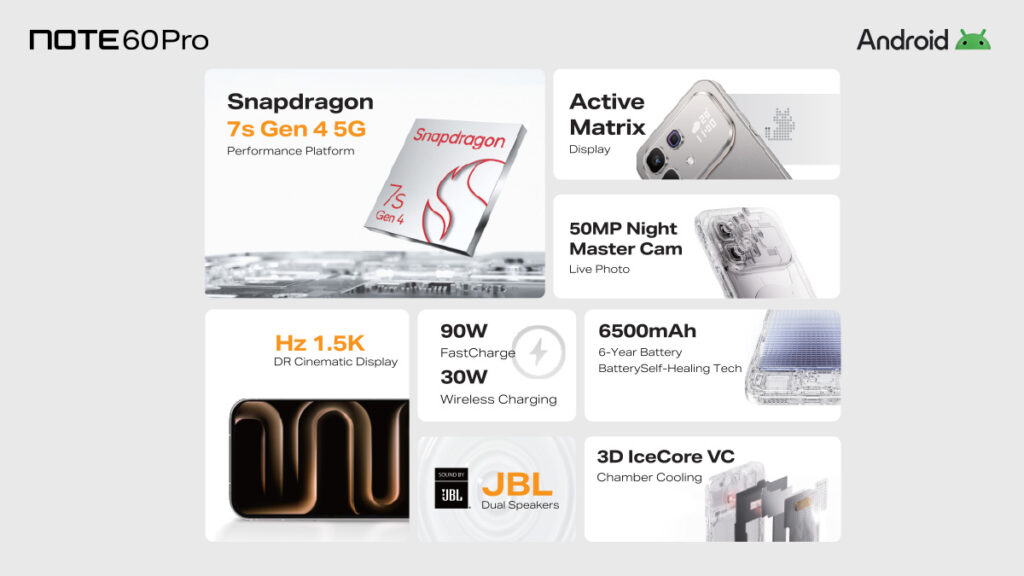
Infinix paired the aluminum construction with a Qualcomm Snapdragon 7s Gen 4 processor that scores approximately 874,000 points on AnTuTu 10, a 6.78-inch 144Hz AMOLED display with 4500 nits peak brightness, a 50MP main camera with f/1.6 aperture and OIS, both 90W wired fast charging that fills the 6500mAh battery in 41 minutes and 30W wireless charging, JBL-tuned stereo speakers, health sensors including heart rate and SpO2 monitoring, Android 16 with XOS 16 software, three years of OS updates plus four years of security patches, and a Matrix LED display embedded in the camera module that provides notifications and quick information similar to Nothing Phone’s Glyph interface.
The specifications read like Infinix sat down and decided to include features that mainstream brands charge premium prices for while keeping the overall cost under ₹30,000, and the only question worth asking is whether all these features work well enough to justify choosing this phone over more established competitors from Xiaomi, Realme, or Samsung.
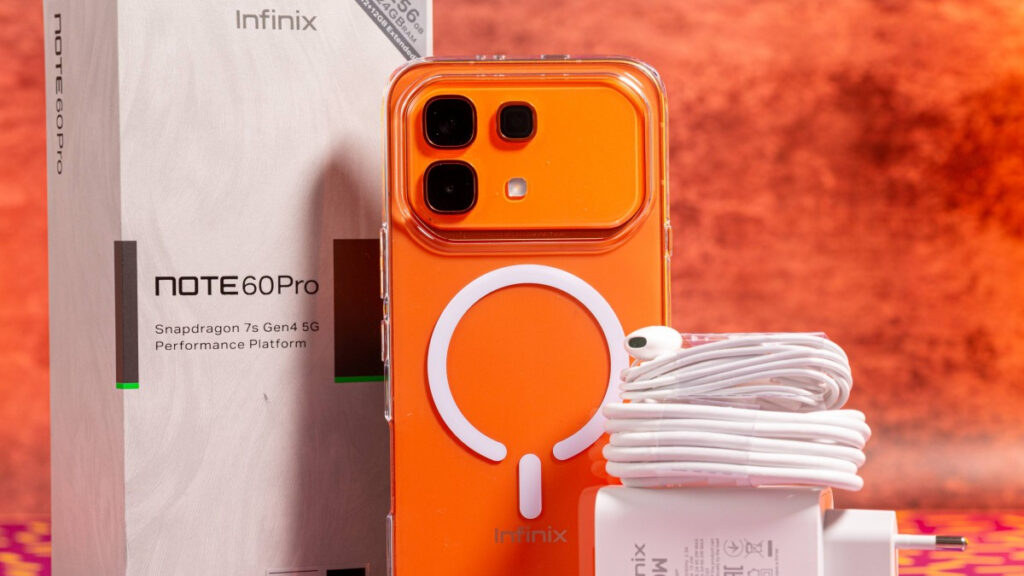
Design, Display, And Build Quality: When Material Choice Defines The Experience
The Infinix Note 60 Pro measures 162.4mm tall, 77.2mm wide, and 7.4mm thick while weighing 201.7 grams, making it noticeably slimmer than most phones with 6500mAh batteries that typically exceed 8mm thickness. The phone uses Corning Gorilla Glass 7i on the front, an aluminum alloy frame, and an aluminum alloy back panel. That aluminum back represents the phone’s most distinctive feature and requires extended discussion because it fundamentally changes how the device feels and performs.
Aluminum conducts heat more efficiently than glass or plastic, which means the phone dissipates thermal energy across its entire surface rather than concentrating heat in specific areas. During demanding tasks like gaming or video recording, the aluminum back becomes noticeably warm to the touch, but this warmth spreads evenly rather than creating hot spots, and the efficient heat dissipation actually helps the processor maintain performance longer before thermal throttling reduces clock speeds.
The aluminum surface resists fingerprints better than glass backs, doesn’t crack when dropped like glass backs do, and provides a premium tactile experience that plastic can’t match.
The phone comes in six color options including Mist Titanium, Deep Ocean Blue, Solar Orange, Mocha Brown, Torino Black, and Frost Silver, with the Solar Orange variant drawing particular attention for its iPhone 17 Pro-inspired appearance with the large horizontal camera platform. The camera module design integrates a Matrix LED display, which is a small LED panel embedded in the camera island that shows notifications, battery status, charging animation, music visualization, and custom patterns.
This implementation mirrors the Nothing Phone’s Glyph interface but uses an actual display rather than individual LED strips, providing more flexibility for information display though potentially consuming more power. The LED matrix responds to notifications by showing relevant icons, displays charging progress with animated patterns, visualizes music playback with equalizer-style animations, and can show custom patterns for specific contacts or apps.
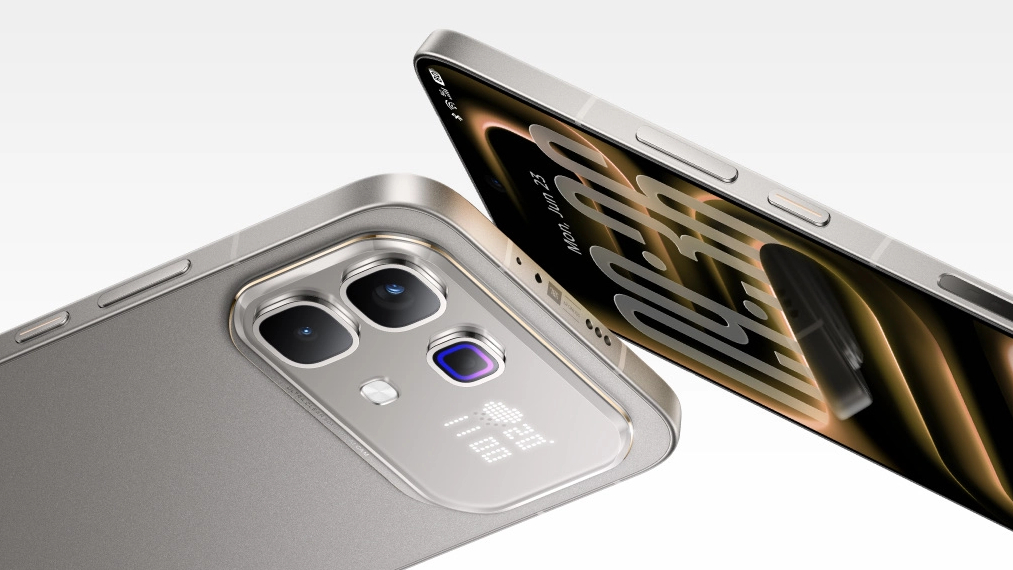
Whether this feature represents genuine utility or gimmicky differentiation depends on your usage patterns and tolerance for attention-grabbing design elements.
The IP64 rating provides dust-tight protection and resistance to water splashes from any direction, which means the phone can survive rain and accidental spills but shouldn’t be submerged in water. This matches most competitors at this price point and provides adequate protection for realistic daily usage scenarios.
The side-mounted fingerprint sensor integrated into the power button responds quickly according to early user reports, and the optical under-display sensor would likely require ultrasonic technology to match the speed and reliability of physical sensors. The phone supports dual nano-SIM cards plus eSIM capability with a maximum of two active SIMs at once, providing flexibility for users who maintain separate work and personal numbers or frequently travel internationally.
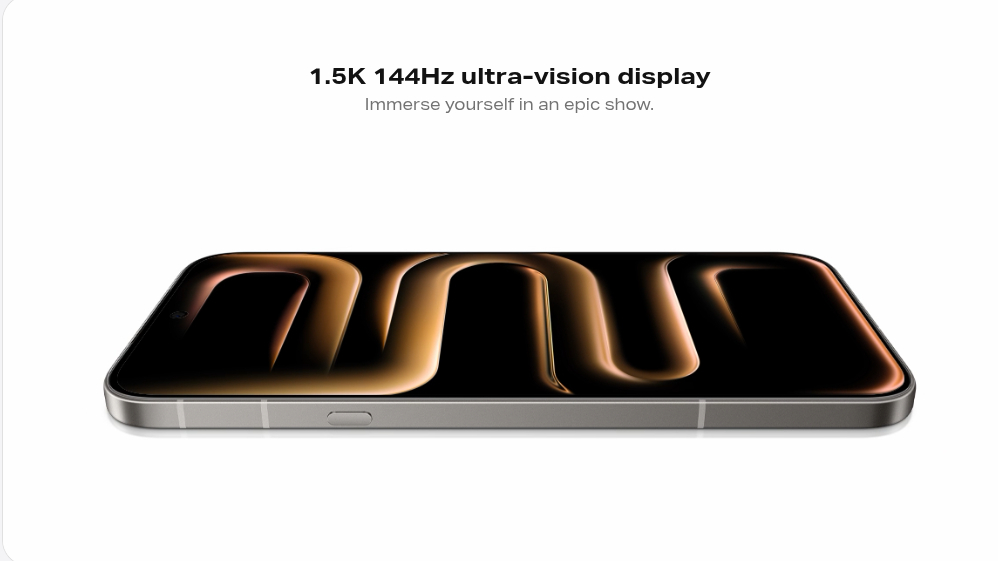
The 6.78-inch AMOLED display uses 1208 x 2644 pixel resolution, which works out to 429 pixels per inch. This isn’t the absolute sharpest display available but provides perfectly adequate clarity for text, photos, and videos without visible pixelation under normal viewing conditions. The 144Hz refresh rate exceeds the 120Hz standard found on most competing phones, making scrolling feel noticeably smoother and game animations more fluid when playing supported titles.
The display supports 2304Hz PWM dimming rather than the DC dimming Infinix claims, with the high PWM frequency reducing eye strain for people sensitive to screen flicker. The 700 nits typical brightness, 1600 nits High Brightness Mode, and 4500 nits peak brightness provide excellent outdoor visibility with the screen remaining clearly legible even in direct tropical sunlight.
The display supports Ultra HDR for enhanced dynamic range in compatible content, DCI-P3 wide color gamut for vibrant accurate colors, TÜV Rheinland certification for eye comfort, and 1500Hz instantaneous touch response rate for competitive gaming where millisecond input latency matters.
The display uses a flat panel rather than curved edges, which makes screen protector installation straightforward, eliminates accidental edge touches, and provides uniform brightness from edge to edge without the color shift that curved displays sometimes exhibit. The bezels measure reasonably slim without going to extremes, creating an 89.4% screen-to-body ratio that looks modern without requiring complicated engineering that drives up costs.
The Corning Gorilla Glass 7i protection sits somewhere between Gorilla Glass 5 and Gorilla Glass Victus in terms of scratch and impact resistance, providing adequate durability for normal use without the premium pricing of flagship glass protection.
Camera Performance of the Infinix Note 60 Pro 5G: Competent Hardware, Developing Software
The Infinix Note 60 Pro features a dual rear camera setup consisting of a 50MP primary sensor with f/1.6 aperture, 0.8µm pixel size, PDAF autofocus, and optical image stabilization, plus a 2MP depth sensor that exists mainly to assist portrait mode rather than contribute meaningful photographic capability. The front camera uses a 13MP sensor with f/2.2 aperture and 1.12µm pixel size. Let’s establish expectations immediately because this matters.
The camera hardware is competitive for a ₹26,000 phone, but Infinix’s image processing software doesn’t match the sophistication of brands like Samsung, Google, or even Xiaomi that have invested years in computational photography algorithms.
The 50MP main sensor with its bright f/1.6 aperture captures detailed photos in bright daylight with good color saturation, acceptable dynamic range, and adequate detail retention when zooming or cropping. The optical image stabilization genuinely helps with both photography and video by compensating for hand shake, keeping night shots sharper and video footage smoother than phones relying solely on electronic stabilization.
In medium lighting conditions like indoor spaces with overhead lights or cloudy outdoor days, image quality remains acceptable with some increase in noise and slight reduction in dynamic range where bright areas begin washing out and shadow areas lose detail. In low light conditions like restaurants, evening scenes, or dimly lit interiors, the camera produces usable photos with visible grain and reduced detail, though the OIS helps maintain sharpness by allowing slightly longer exposures without motion blur ruining the shot.
Infinix included AI-powered features to enhance photography including AI Scene Detection that recognizes 20+ different scenes and adjusts processing accordingly, AI Portrait Mode with enhanced subject recognition and natural background blur, AI Night Mode that combines multiple exposures for brighter cleaner low-light photos, AI HDR that balances exposure across bright and dark areas, AI Beauty Mode for selfie enhancement, and Document Mode with automatic perspective correction for photographing text.
These AI features work reasonably well when they correctly identify scenes, though the aggressive processing sometimes produces oversaturated colors and oversharpened details that look dramatic on the phone screen but artificial when viewed on larger displays.
The 2MP depth sensor assists with portrait mode by providing depth information for more accurate subject separation, though edge detection quality depends primarily on software algorithms rather than the depth sensor itself. Portrait shots in good lighting show acceptable subject-background separation with blur that looks reasonably natural, though edge detection occasionally fails around hair, glasses, or other complex shapes where the algorithm struggles to distinguish foreground from background.
The 13MP selfie camera produces acceptable selfies for social media and video calls in good lighting, with support for 4K video recording at 30fps and 1080p at up to 60fps. The front camera includes AI beauty mode and HDR support for improved selfie quality, though low-light selfie performance is mediocre with noticeable noise and loss of detail.
The camera can record 4K video at 30fps from both front and rear cameras, plus 1080p video at up to 120fps for slow-motion effects. The combination of optical and electronic image stabilization produces smooth handheld footage that looks professional rather than shaky, and the hybrid stabilization system represents a genuine advantage over phones relying solely on electronic stabilization that crops the frame and reduces video resolution.
Infinix included Dual-View Video Mode that records from both front and rear cameras simultaneously, which is useful for vloggers and content creators who want reaction videos or need to show both themselves and what they’re seeing.
The practical reality is that photography enthusiasts focused primarily on camera quality should look at phones like the Realme GT series, Nothing Phone, or Samsung Galaxy A series that offer more refined image processing despite sometimes using smaller sensors. But for users whose photography needs consist primarily of social media posts, WhatsApp sharing, and everyday documentation, the Note 60 Pro’s camera system is perfectly adequate and the inclusion of OIS at this price point genuinely adds value.
Processor Performance And Gaming Performance: Balanced Mid-Range Capability
The Qualcomm Snapdragon 7s Gen 4 processor built on a 4nm manufacturing process represents Infinix’s first phone using this chipset, positioning the Note 60 Pro as a performance-focused device rather than a pure budget offering. The chip features an octa-core configuration with one Cortex-A720 core running at 2.7 GHz, three Cortex-A720 cores at 2.4 GHz, and four Cortex-A520 efficiency cores at 1.8 GHz, paired with the Adreno 810 GPU.
According to AnTuTu 10 benchmark testing, the Snapdragon 7s Gen 4 scores approximately 874,000 points, placing it in solid mid-range territory above budget processors like the Dimensity 6000 series but below flagship chips like the Snapdragon 8 Gen series that score over 2 million points. To provide context, this represents roughly 45% better performance than the Dimensity 7200 that powered last year’s mid-range phones, marking a genuine generational improvement rather than incremental gains.
For daily tasks including social media browsing, web surfing, YouTube and Netflix streaming, WhatsApp and other messaging apps, email management, and photo capture, the Snapdragon 7s Gen 4 handles everything smoothly without noticeable lag. Apps launch quickly, the interface remains responsive during normal use, and switching between a reasonable number of apps happens instantly without reloading delays.
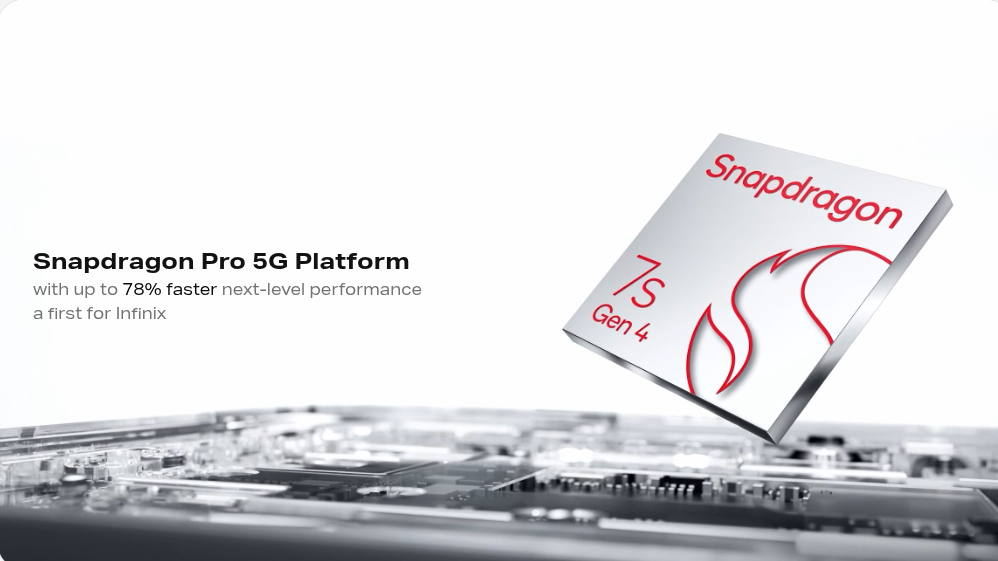
For gaming, the Adreno 810 GPU provides capable performance that handles popular mobile games at respectable settings. BGMI runs consistently at 60fps on high graphics settings with stable frame times. Call of Duty Mobile achieves 60fps at high settings or 90fps with reduced graphics quality. Genshin Impact plays smoothly at medium settings achieving 45-50fps, though high settings cause frame rate to drop into the 30s during intense combat sequences. Free Fire, Candy Crush, and similar lightweight titles run at maximum settings without issues.
Infinix included a 3D IceCore vapor chamber cooling system measuring 7000 square millimeters plus additional thermal layers for total heat dissipation area exceeding 35,000 square millimeters. This extensive cooling combined with the aluminum back’s efficient heat dissipation allows the Snapdragon 7s Gen 4 to maintain high clock speeds longer before thermal throttling reduces performance to prevent overheating.
Under sustained gaming sessions lasting 30 minutes or more, the phone gets warm but doesn’t become uncomfortably hot, and performance remains more consistent than phones with smaller cooling systems that throttle aggressively after 10 to 15 minutes of intensive use. The aluminum back spreads heat across its entire surface so the phone feels warmer overall than a plastic phone would, but the internal components actually run cooler because heat dissipates efficiently rather than concentrating in specific areas.
Infinix paired the Snapdragon 7s Gen 4 with either 8GB or 12GB of LPDDR4X RAM plus 256GB of UFS 2.2 storage. The RAM configuration provides adequate memory for heavy multitasking, keeping multiple apps running simultaneously without frequent reloading, though the LPDDR4X specification is older than LPDDR5 or LPDDR5X found in more expensive phones. The UFS 2.2 storage has sequential read speeds around 900 MB/s and write speeds around 500 MB/s, which is noticeably slower than UFS 3.1 (2100 MB/s read) or UFS 4.0 (4200 MB/s read) found in phones costing slightly more.
Apps install reasonably quickly and games load acceptably fast, though users upgrading from phones with UFS 3.1 or faster storage will notice the difference in loading times and file transfers. The lack of microSD expansion means buyers are locked into the 256GB capacity, though for most users this provides adequate space for apps, photos, and videos without constantly managing storage.
The practical reality is that the Snapdragon 7s Gen 4 in 2026 provides competent mid-range performance that handles popular games adequately, processes everyday tasks smoothly, and maintains acceptable performance during extended use. Users wanting the absolute maximum gaming performance should look at phones with Dimensity 8350 or Snapdragon 8 Gen 5 processors, but for users whose gaming consists primarily of popular titles rather than the most demanding games at maximum settings, the 7s Gen 4 provides satisfying performance at a reasonable price.
Connectivity And Battery Life: The Dual Charging Advantage
The battery situation is where the Infinix Note 60 Pro genuinely impresses by including features usually reserved for phones costing ₹40,000 or more. The phone contains either a 6000mAh or 6500mAh battery depending on the market variant, with Indian units expected to include the larger 6500mAh capacity.
In normal usage patterns including social media browsing, WhatsApp messaging, YouTube video streaming, occasional mobile gaming, photography, and web browsing with mixed Wi-Fi and 5G connectivity, user reports suggest the Note 60 Pro delivers one and a half to two full days of use with moderate screen-on time. Heavy users who spend hours gaming or streaming video continuously will still get a full day plus several additional hours, which beats most mid-range phones that require daily charging.
The 90W fast charging reaches 50% capacity in 16 minutes and full charge in 41 minutes according to Infinix’s specifications, with real-world testing confirming these figures. The 90W charger is included in the box, which seems obvious but increasingly manufacturers are removing chargers to reduce costs and packaging size. But here’s where the Note 60 Pro becomes genuinely interesting. Infinix included 30W wireless charging, which is extremely rare at this price point.
Most manufacturers reserve wireless charging for their flagship offerings costing ₹50,000 or more, arguing that budget buyers don’t care about convenience features. Infinix apparently disagrees, including 30W wireless charging that reaches full charge in approximately 90 minutes, providing genuine convenience for users who prefer wireless charging despite slower speeds compared to wired charging.
Infinix claims the battery includes six years of self-healing technology that can reportedly repair damage caused by repeated charging and discharging cycles, maintaining battery capacity longer than conventional batteries that typically degrade to 80% capacity after 800 to 1000 charge cycles. The self-healing technology allegedly prevents dendrite formation that reduces battery capacity over time, though independent long-term testing will be required to verify whether this actually extends battery lifespan beyond conventional lithium-polymer cells.
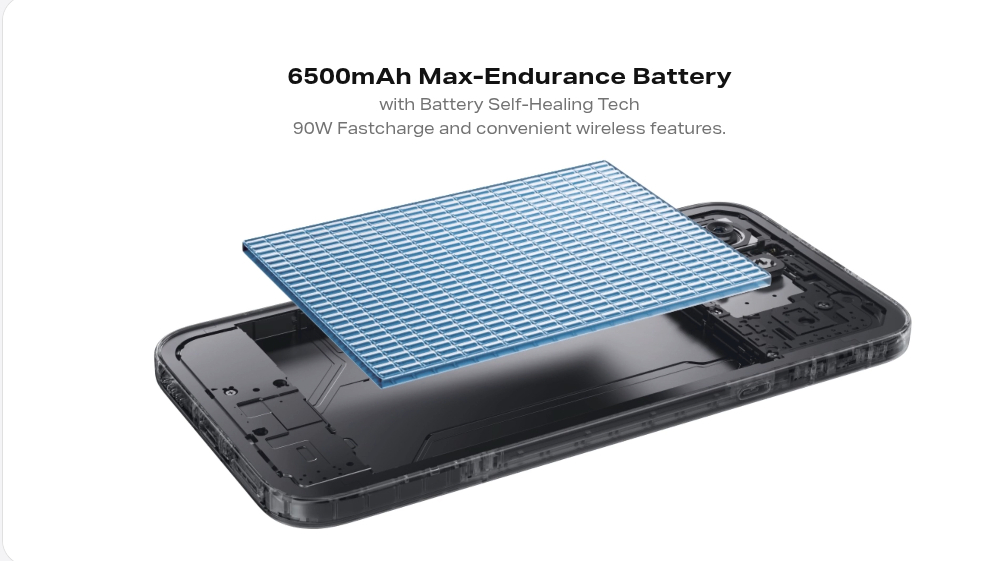
If the self-healing claims prove accurate, the battery should maintain 85% to 90% capacity after three to four years of daily charging, which would genuinely extend the phone’s usable lifespan beyond typical budget phones that require battery replacement after two to three years.
The connectivity suite includes 5G support for SA/NSA networks though specific band support isn’t detailed in the specifications, dual nano-SIM plus eSIM capability with maximum two active SIMs simultaneously, Wi-Fi 6 (802.11ax) with dual-band 2.4GHz and 5GHz connectivity, Bluetooth 5.4 with A2DP and LE for wireless accessories, GPS positioning though additional satellite systems aren’t specified, NFC for contactless payments, infrared port for controlling televisions and air conditioners, FM radio, and USB Type-C 2.0 port providing charging and data transfer though only at USB 2.0 speeds rather than faster USB 3.0 or 3.1 standards.
The audio setup includes dual stereo speakers tuned by JBL, which produce reasonably loud clear sound with better spatial separation than single-speaker phones though lacking the deep bass of phones with larger speaker chambers. The speakers get loud enough for watching videos or casual music listening without headphones, and the JBL tuning prevents distortion at high volumes that plagues cheaper speakers.
There’s no 3.5mm headphone jack, following industry trends, though audio quality over USB-C or Bluetooth is acceptable for wired or wireless headphones. The phone includes health sensors that most manufacturers abandoned years ago, specifically a heart rate monitor and SpO2 sensor for blood oxygen measurement. These sensors work through the optical sensors on the back of the phone, requiring users to place their finger on the sensor area for measurement.
The accuracy of these sensors for medical purposes is questionable, but they provide reasonable estimates for fitness tracking and general health monitoring.
Software And User Experience: Android 16 With Infinix Customization
The Infinix Note 60 Pro ships with Android 16 with XOS 16 customization layer, giving users the latest Google software paired with Infinix’s feature additions and interface modifications. Infinix promises three major Android updates (Android 17, Android 18, Android 19) plus four years of security patches, which represents better long-term support than most budget brands provide and demonstrates Infinix’s commitment to keeping their devices secure and functional long after purchase.
Android 16 includes improved privacy controls, better notification management, enhanced multitasking features, and various under-the-hood performance optimizations that benefit every app. XOS 16 adds extensive customization options including themes, icon packs, always-on display designs, and numerous settings for controlling animations, transitions, and visual effects.
The software includes pre-installed apps that generate revenue for Infinix through advertising or partnerships, and users will need to spend time uninstalling or disabling apps they don’t want. The bloatware situation appears less aggressive than Xiaomi’s MIUI or Realme’s Realme UI, but XOS still includes more pre-installed apps than stock Android or Samsung’s OneUI.
The aggressive battery optimization helps achieve the impressive battery life but will kill background apps unless specifically whitelisted, which can be annoying for messaging apps, music players, or other services users want running continuously. Users need to spend time configuring battery management settings to whitelist important apps, but once properly configured, the system works well.
XOS 16 includes features like Game Mode that optimizes system resources for gaming by closing background apps and allocating more RAM to active games, Smart Panel for quick access to frequently used functions, Multi-Window Mode for running two apps simultaneously with split-screen view, Screen Recording with audio capture, and various AI-powered features including AI Smart Assistant, AI Photo Enhancement, AI Scene Recognition, and AI Beauty Mode.
The interface feels typical of Chinese Android customization with some genuinely useful features mixed with unnecessary additions that some users will appreciate and others will find cluttered compared to cleaner Android implementations.
The Competitive Context: Unusual Positioning
The mid-range segment around ₹26,000 in 2026 is intensely competitive with nearly every manufacturer offering devices that make different trade-offs. The Infinix Note 60 Pro prioritizes build quality with its aluminum back, includes both fast wired and wireless charging, and provides health sensors most competitors omit.
Competing options include the Lava Agni 4 at ₹25,000 offering cleaner software and USB 3.2 connectivity but slightly older processor, the Xiaomi Redmi Note 15 Pro offering similar specifications with more established brand recognition and retail presence, the Realme GT Neo offering better processor performance with smaller battery capacity, the Samsung Galaxy M series providing better brand value and longer update commitments but slower charging and plastic construction, and the Nothing Phone (3a) Lite offering unique glyph lighting and arguably better cameras but similar or higher pricing without wireless charging.
The Note 60 Pro represents excellent value specifically for users who appreciate premium materials and want both wired and wireless charging flexibility at a mid-range price. For users who prioritize brand recognition, software cleanliness, or absolute maximum performance, competing phones make different compromises that might better suit their needs.
Is This Smartphone For You?
The Infinix Note 60 Pro makes sense for users who value build quality and appreciate the premium feel of aluminum construction at a mid-range price point. It makes sense for people who want both fast wired charging and the convenience of wireless charging without paying flagship prices. It makes sense for users interested in basic health monitoring through heart rate and SpO2 sensors. It makes sense for buyers who need multiple days of battery life with a 6500mAh capacity that eliminates daily charging anxiety.
It makes sense for users upgrading from older phones where the Snapdragon 7s Gen 4 represents a significant performance improvement. And it makes sense for people who appreciate unique design elements like the Matrix LED notifications that provide at-a-glance information without activating the main display.
The Infinix Note 60 Pro does not make sense for users who prioritize photography and need consistently excellent results in varied lighting conditions, because the camera processing doesn’t match more established brands despite capable hardware. It doesn’t make sense for hardcore mobile gamers who want maximum performance in demanding titles, because the Snapdragon 7s Gen 4 is mid-range rather than flagship.
It doesn’t make sense for users who expect pristine software experiences without bloatware or customization, because XOS includes pre-installed apps and heavy interface modifications. It doesn’t make sense for buyers who value brand recognition and resale value, because Infinix lacks the mainstream appeal of Samsung, Xiaomi, or Realme. And it doesn’t make sense for users who need microSD expansion, because the Note 60 Pro omits expandable storage.
TattwaTech Score – 7.8 Out Of 10
The Infinix Note 60 Pro succeeds at delivering premium materials and flagship features at a mid-range price point, proving that budget phones don’t need to compromise on build quality or charging flexibility. The aluminum back creates a tactile experience usually reserved for phones costing twice as much, the inclusion of both 90W wired and 30W wireless charging genuinely adds convenience that competing phones omit, and the 6500mAh battery provides multi-day endurance that eliminates daily charging routines.
The Snapdragon 7s Gen 4 offers capable performance for popular games and everyday tasks, the 144Hz AMOLED display competes with phones in higher price brackets, and the three years of OS updates demonstrates Infinix’s commitment to long-term support. But the UFS 2.2 storage feels outdated in 2026 when faster options cost only marginally more, the camera processing doesn’t match more established brands despite capable hardware, and the XOS software includes bloatware that requires cleanup effort.
For users who appreciate premium materials, want charging flexibility, and need multi-day battery life at a reasonable price, the Note 60 Pro represents genuine value that competing phones don’t replicate. For users who prioritize software cleanliness, absolute maximum performance, or photography excellence, the Note 60 Pro’s particular compromises make competing phones more attractive despite lacking the aluminum construction and wireless charging.
Infinix has created a phone that rewards buyers for looking past brand logos and evaluating what actually matters in daily use, and the aluminum back alone makes this device feel special in a segment dominated by plastic.





[…] is one of the strongest points here. Huawei says it analysed over 10,000 human ear profiles and went through more than 1,000 earbud shapes and 60 ear tip […]