BSNL 5G in India: What Is Live, What Is Coming, and What You Really Need to Know

BSNL 5G is one of the most searched topics in Indian telecom and also one of the most misunderstood. Viral videos claim 5G is already live. News articles give different launch dates. Official statements keep shifting. This guide gives you the honest answer: what is actually available today, and when mobile 5G will realistically reach your phone.
What Is Actually Live: The Honest Answer
As of March 7, 2026, BSNL has not launched nationwide mobile 5G service for the general public. If you are a BSNL mobile subscriber, you are on 4G right now. In many areas, 4G coverage itself is still being expanded.
Here is what is actually available today:
- Quantum 5G FWA (Fixed Wireless Access): A home broadband service that uses 5G radio signals instead of a fibre cable. Soft-launched in Hyderabad in June 2025. Pilot cities include Bengaluru, Chandigarh, Gwalior, Pondicherry, Pune, and Visakhapatnam.
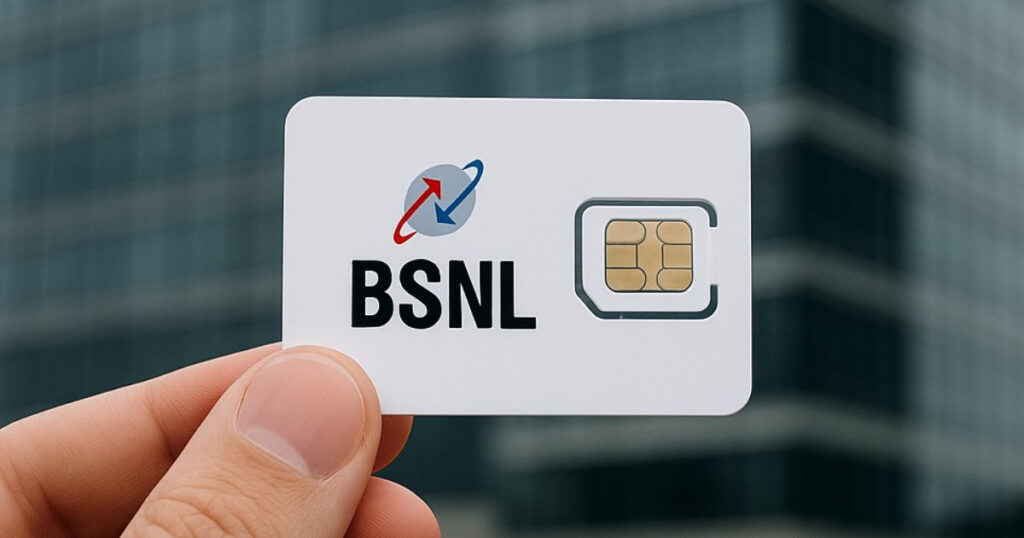
- Q-5G SIM cards: BSNL is distributing 5G-ready SIM cards as part of its 4G rollout. These SIMs support 5G architecture but the mobile 5G network is not yet active for most users.
- Pilot testing sites: BSNL has run 5G tests at locations in New Delhi including Nehru Place, Chanakyapuri, and Minto Road. Telecom Minister Jyotiraditya Scindia has demonstrated 5G video calls using BSNL’s indigenous network.
And here is what is not yet live for regular users:
- Nationwide mobile 5G on smartphones
- Commercial 5G mobile plans for subscribers
- 5G coverage outside testing and pilot areas
A video circulating on Instagram and other social platforms in early March 2026 claimed that BSNL had quietly launched 5G SIM cards and that 5G was now live across India. LatestLY fact-checked this on March 7, 2026, and rated it misleading. The Q-5G SIM card is a future-ready SIM distributed during the 4G rollout. Holding one does not mean 5G is active in your area.
BSNL Quantum 5G FWA: Home Internet Without the Cable
BSNL Quantum 5G FWA stands for Fixed Wireless Access. It is a home broadband service, not a mobile service. Instead of needing a fibre cable laid to your home, you get a small gateway device that receives 5G signals from a nearby BSNL tower and provides Wi-Fi inside your house.
The device installs on your rooftop or near a window. It connects to BSNL’s 5G tower automatically. No technician needs to dig up the street or drill through your walls. BSNL says the gateway is designed for self-installation and already covers 85 percent of households in Hyderabad using the existing BSNL tower grid.
What the Hyderabad Pilot Showed
During the soft launch at the Ameerpet Exchange in Hyderabad on June 18, 2025, the Quantum 5G FWA system recorded download speeds of 980 Mbps and upload speeds of 140 Mbps with latency below 10 milliseconds. These are very strong numbers for a home broadband service. For comparison, a 4K video stream needs about 25 Mbps and a video call needs around 5 Mbps.
The service runs on 700 MHz and 3.3 GHz spectrum bands using fully indigenous technology built by BSNL, C-DOT, Tejas Networks, and TCS. It is also SIM-less, meaning the gateway device authenticates directly without needing a physical SIM card. BSNL calls this its Direct-to-Device platform and says it is the first production-grade SIM-less 5G service from any Indian operator.
Current Plans and Pricing
BSNL has announced two introductory plans for the Quantum 5G FWA service:
- 999 per month for 100 Mbps speeds
- 1,499 per month for 300 Mbps speeds
These prices sit in a similar range to Jio AirFiber and Airtel Xstream AirFiber. BSNL says more pricing tiers will be added over time and that commercial rollout will follow after field feedback from the pilot cities. The service is initially focused on home users and small businesses (MSMEs) in areas where optical fibre cables are not accessible.
Note: The Quantum 5G FWA service currently provides internet only and does not support voice calls. It is a data service delivered through a router, similar to how Jio AirFiber and Airtel Xstream Fiber work.
BSNL 5G Launch Timeline: Official Statements Only
Confusion about when BSNL 5G will launch has been building for over a year because different officials have stated different timelines at different points in time. The table below is built only from confirmed official statements, with the source and date included so you can see how reliable each milestone is.
| Period | Official Statement or Milestone | Status (March 2026) |
| May 2023 | BSNL signed Rs. 15,000 crore contract with TCS for 4G equipment covering 100,000 towers (C-DOT, Tejas Networks, ITI Ltd included). | Completed |
| Mid-2024 | BSNL had deployed approximately 9,000 4G towers. Rollout significantly behind the original schedule. | Completed (delayed) |
| June 18, 2025 | Quantum 5G FWA soft-launched in Hyderabad (CMD Robert Ravi). Pilot expansion to 6 more cities planned by September 2025. | Live in pilot cities |
| October 2025 | Telecom Minister Scindia confirmed all 4G towers will be upgraded to 5G within 6 to 8 months. Around 98,000 4G sites now active (Source: Moneycontrol, India TV News). | Confirmed plan |
| December 2025 | DoT official stated commercial 5G launch in Delhi and Mumbai by December 2025 (Source: RCR Wireless, India TV News). | Not achieved |
| Feb 17, 2026 | CMD Robert Ravi told Business Standard: soft launch of 5G in Delhi expected in approximately 6 months. Most recent confirmed official statement. | Target: ~Aug 2026 |
| Mid-2026 | BSNL plan: extend 5G mobile service to all metros and state capitals. | Planned |
| Late 2026 | BSNL plan: begin rural 5G rollout using existing tower network and BharatNet infrastructure. | Planned |
The most recent official statement on mobile 5G is from BSNL CMD Robert Ravi on February 17, 2026. He confirmed to Business Standard that a soft launch in Delhi is expected in around six months, pointing to approximately August 2026. Given that the December 2025 target was not met, treat this as a target rather than a guarantee.
Your Q-5G SIM Card: What It Does and Does Not Do Right Now
BSNL has been distributing a new type of SIM card called the Quantum 5G SIM or Q-5G SIM during its nationwide 4G rollout. This has caused a lot of confusion online, with many people believing that receiving one of these SIM cards means 5G is now active in their area.
Here is what the Q-5G SIM actually is. It is a physically upgraded SIM card that uses stronger encryption and is built to support 5G network architecture when the service becomes available. The word Quantum in the name refers to quantum-resistant encryption, a security standard designed to protect against future threats. It does not mean you are connected to a quantum or 5G network right now.
The practical benefit of the Q-5G SIM is that you will not need to visit a BSNL store to swap your SIM card when 5G launches in your area. The SIM will automatically activate 5G once BSNL switches on the 5G towers near you. This is why BSNL is distributing these SIMs now, during the 4G rollout, rather than waiting until 5G is ready.
If you have received a Q-5G SIM from BSNL: your phone is on 4G right now. That is correct. 5G will activate automatically in your area when BSNL upgrades the local towers. You do not need to do anything.
How BSNL Is Building 5G: The Atmanirbhar Telecom Stack
The reason BSNL’s 5G path looks different from Jio and Airtel is that India made a deliberate choice to build its own telecom technology rather than buy equipment from global vendors.
When Jio and Airtel launched 5G in October 2022, they used equipment from companies like Ericsson, Nokia, and Samsung. This is fast and proven, but it means depending on foreign suppliers for critical national infrastructure. BSNL was directed to take a different approach.
Three Indian organisations built BSNL’s 4G and 5G stack together:
- C-DOT (Centre for Development of Telematics): A government research organisation that developed the 4G core network software. The core is the brain of the network. It manages all connections, routes data, and handles subscriber accounts.
- Tejas Networks: An Indian networking company that built the Radio Access Network (RAN) hardware. This is the equipment inside the towers that sends and receives signals to and from your phone.
- TCS (Tata Consultancy Services): The systems integrator, responsible for putting all the pieces together and deploying the network across India at scale. BSNL’s contract with TCS is valued at approximately Rs. 15,000 crore.
The key technical advantage of this approach is that all the 4G equipment was built from the start to be upgradeable to 5G through a software update and minor hardware additions. This means BSNL does not need to build new towers from scratch to offer 5G. When Communications Minister Scindia confirmed the 6 to 8 month tower upgrade timeline in October 2025, this software-led upgrade path is what makes that timeline possible.
As of March 2026, BSNL has approximately 98,000 4G towers active across India. All of them are 5G-upgradeable. BSNL is also exploring a second set of 100,000 additional 4G towers, which would further expand the base for 5G coverage.
BSNL 5G vs Jio 5G vs Airtel 5G: A Straight Comparison
Here is an honest comparison of where each operator stands on 5G as of March 2026.
| Factor | BSNL 5G | Jio 5G | Airtel 5G |
| Mobile 5G for smartphones | Not yet live for general public | Nationwide since Oct 2022 | Nationwide since Oct 2022 |
| Fixed wireless 5G (home broadband) | Quantum 5G FWA: live in select cities | JioAirFiber: nationwide | Xstream AirFiber: nationwide |
| Technology source | 100% indigenous (C-DOT, Tejas, TCS) | Foreign vendors (Ericsson, Nokia, Samsung) | Foreign vendors (Ericsson, Nokia) |
| Approx. 5G towers active | Testing phase only | 500,000+ | 450,000+ |
| Expected mobile 5G launch | Soft launch in Delhi ~Aug 2026 (per CMD) | Already live | Already live |
| Rural coverage strength | Very strong legacy rural network | Strong in cities, limited in remote areas | Strong in cities, limited in remote areas |
| FWA entry price | Rs. 999/month for 100 Mbps | Rs. 599/month for 30 Mbps (JioFiber) | Rs. 799/month for 40 Mbps (Xstream) |
The comparison tells a clear story. Jio and Airtel have a head start of more than three years in mobile 5G and a much larger tower count. BSNL is competitive on FWA pricing and has genuine structural advantages in rural coverage. The mobile 5G gap will narrow through 2026 but it will not close overnight.
What BSNL 5G Could Mean for Rural India
The biggest long-term opportunity for BSNL 5G is not in the metros. Jio and Airtel have already built strong urban 5G networks. Where BSNL can have a real and lasting impact is in rural and semi-urban India.
BSNL has approximately 91 to 93 million subscribers as of early 2026. A large proportion of these are in smaller towns, villages, and regions that private operators have historically found less profitable to serve. BSNL has towers in places where Jio and Airtel do not, including remote mountainous areas, island territories, and regions in Jharkhand and Chhattisgarh where connectivity was previously very limited.
As BSNL’s 4G towers upgrade to 5G, users in these areas will move directly from basic connectivity to high-speed internet without waiting for private operators to find commercial reasons to invest in those regions. This is the single most important competitive advantage BSNL has that no amount of Jio or Airtel tower spending can easily replicate.
BSNL CMD Robert Ravi has also outlined an edge computing plan for BharatNet infrastructure. Under this model, gram panchayats (village governing bodies) would act as local computing nodes, processing data close to users rather than routing everything to distant data centres. Combined with an AI-managed network and a remote fibre monitoring system, this could eventually turn BSNL’s rural infrastructure from a basic connectivity pipe into a platform for telemedicine, agricultural technology, and government digital services.
Whether this vision is achieved depends entirely on execution. Which brings us to the honest part.
The Real Challenges: Why BSNL 5G Is Not a Sure Thing
BSNL’s 5G plans deserve honest scrutiny. Several real challenges stand between the current state and a successful nationwide rollout.
Missed Deadlines Are a Pattern
BSNL’s 4G rollout was originally supposed to be complete by December 2024. That date was missed. The target moved to March 2025, which was also not met. A December 2025 target for 5G in Delhi and Mumbai was also not achieved. The current official target is a soft launch in Delhi around August 2026. Given this track record, all timelines should be treated as targets rather than certainties.
Limited Competition in the 5G Tender
BSNL floated a tender for a 5G Standalone network in Delhi. While 29 companies attended the pre-bid meeting, only three reportedly progressed: Tejas Networks, Lekha Wireless, and Galore Network. Limited vendor participation in a tender of this scale can affect both the pace and the final quality of deployment.
Device Compatibility
For mobile 5G to work on a smartphone, the phone needs to be 5G-capable. Many BSNL subscribers, particularly in rural areas, are on older 4G handsets. Device upgrade cycles in lower-income segments are slow. Even after the 5G network launches, actual 5G usage will grow gradually as subscribers upgrade their phones.
Subscriber Base and Market Share
BSNL has around 91 to 93 million mobile subscribers, which gives it a market share of under 8 percent. Jio has over 480 million subscribers and Airtel has over 240 million. Launching 5G solves only part of the problem. For BSNL to gain subscribers from private operators, it also needs to offer consistent service quality, competitive pricing, and better customer support, all of which have historically been weaker at BSNL than at its private competitors.
Revenue Sharing Model Complexity
BSNL’s 5G SA tender for Delhi uses a revenue-sharing model where vendors invest the capital and then share revenue with BSNL, with BSNL requiring at least 70 percent of the revenue. This reduces BSNL’s need to spend upfront capital. But it creates a complex commercial arrangement that could slow down how quickly vendors are willing to deploy.
BSNL 5G FAQ: Answers to the Questions People Are Actually Asking
Is BSNL 5G available in my city right now?
Mobile 5G is not yet available for general smartphone users. Fixed wireless (Quantum 5G FWA) is available in Hyderabad and is in pilot stage in Bengaluru, Pune, Chandigarh, Gwalior, Pondicherry, and Visakhapatnam. Contact your nearest BSNL office for local availability of the FWA service.
I received a Q-5G SIM card. Can I use 5G now?
Not yet for most users. The Q-5G SIM is ready for 5G but the mobile 5G network has not been switched on in most areas. Your phone will continue on 4G until BSNL upgrades the towers in your area. You will not need to swap your SIM again when 5G arrives.
When will BSNL 5G mobile service launch?
Based on the latest official statement from BSNL CMD Robert Ravi on February 17, 2026, a soft launch in Delhi is expected in approximately six months, meaning around August 2026. Other cities will follow through late 2026. Rural rollout is planned for late 2026 onwards.
What speeds can I expect from BSNL 5G?
The Hyderabad FWA pilot recorded 980 Mbps on a fixed gateway. Mobile 5G speeds will be lower and will vary based on your location, device, and how many users are connected to the same tower. Realistically, expect speeds of 100 to 500 Mbps in well-covered areas during the initial mobile rollout. BSNL uses 700 MHz and 3.3 GHz spectrum bands.
Will my current 4G phone work on BSNL 5G?
Your 4G phone will continue to work on BSNL’s 4G network after 5G launches. But to access 5G speeds, you need a 5G-capable smartphone. You will not automatically get 5G just because BSNL upgrades the towers near you.
How much will BSNL 5G mobile plans cost?
No official mobile 5G plan pricing has been announced yet. For fixed wireless, BSNL charges Rs. 999 per month for 100 Mbps and Rs. 1,499 per month for 300 Mbps. BSNL has stated that mobile 5G pricing will be competitive and affordable. Expect pricing to be announced closer to the Delhi soft launch.
Is BSNL 5G technology actually Indian-made?
Yes. BSNL’s 4G and 5G network stack is entirely indigenous. C-DOT built the core software, Tejas Networks built the radio hardware, and TCS handles systems integration and deployment. This is a key difference from Jio and Airtel, which use equipment from foreign vendors.
Should I wait for BSNL 5G or switch to Jio or Airtel now?
If you need 5G on your smartphone today, Jio and Airtel have it nationwide. If you want home broadband without fibre cables and live in a pilot city, BSNL’s Quantum 5G FWA is worth checking. If you live in a rural or semi-urban area where BSNL has better coverage than private operators, waiting for BSNL 5G makes sense. If lower pricing is the main reason you want BSNL 5G, wait until official mobile plans are announced, expected around mid-2026.
Bottom Line: Should You Be Excited or Sceptical?
Both. BSNL 5G is real and it is coming. Fixed wireless 5G is already live in select cities. Mobile 5G has a confirmed soft-launch target in Delhi around August 2026. The technology is genuinely indigenous. The government support is strong. The rural coverage advantage is real.
At the same time, BSNL has missed several self-imposed deadlines and the December 2025 mobile 5G launch did not happen as announced. Execution risk is real for any large state-run infrastructure project of this scale.
Watch the Delhi soft launch closely. If BSNL delivers a working mobile 5G service in Delhi around August 2026, the rollout to other cities will follow quickly because the tower infrastructure is already software-upgradeable. That will be the real test of whether BSNL 5G becomes a genuine competitive option or remains a headline that keeps getting pushed forward.