
NVIDIA DLSS 5 Explained: Neural Rendering, What It Does, and When You Can Use It

NVIDIA announced DLSS 5 at GTC 2026. It is the biggest change to the DLSS technology since its launch in 2018, and it works in a completely different way from every previous version. Here is a plain-language explanation of what it is, how it works, and what you need to know before it arrives.
What Is NVIDIA DLSS 5?
NVIDIA DLSS 5 is a new AI-powered graphics technology announced at the GTC 2026 conference on March 17, 2026. It is scheduled to launch in Fall 2026 and will initially be available on RTX 50-series GPUs.
Unlike every previous version of DLSS, DLSS 5 is not a performance technology. It does not make your frame rate higher. It does not upscale a lower-resolution image to a higher one. It does not generate frames that did not exist.
Instead, DLSS 5 is a visual quality technology. It takes what the game engine has already rendered and enhances it by adding photoreal lighting, better material surfaces, more accurate skin rendering, and realistic fabric and hair detail. The goal is to make games look closer to the quality of Hollywood CGI, in real time, while the game is running.
Jensen Huang, NVIDIA’s CEO, described it at GTC as “the GPT moment for graphics,” drawing a parallel to the way ChatGPT represented a step change in what AI language models could do. Whether that comparison proves accurate will become clearer when the technology is available to test independently.
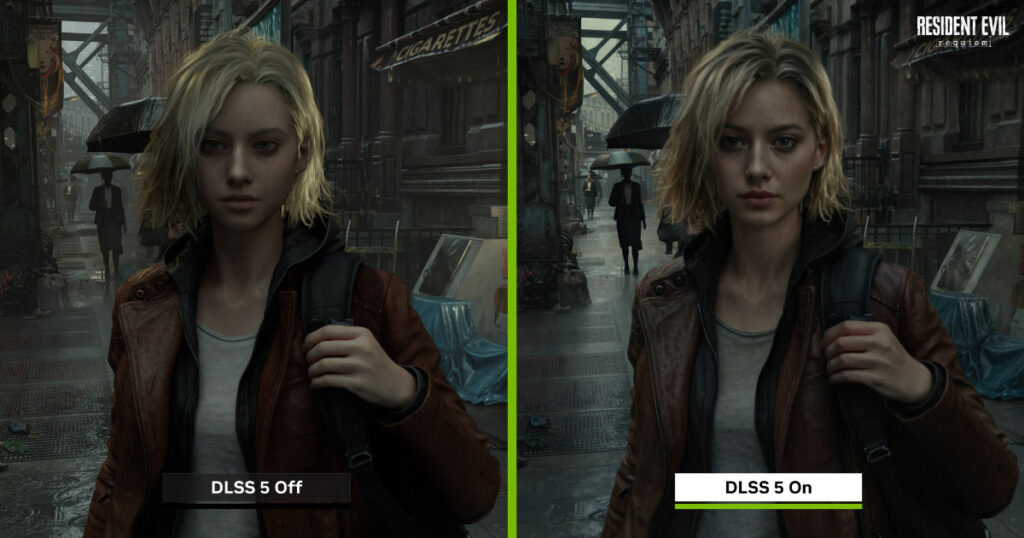
How NVIDIA DLSS 5 Works: Neural Rendering Explained Simply
To understand DLSS 5, it helps to know how games normally create images on screen.
Traditional Rendering: What the GPU Does Now
When a game runs, your GPU builds every frame by calculating geometry, textures, lighting, and shadows using a process called rasterisation. The GPU essentially figures out which pixels each 3D object should produce, then colours them according to the game’s lighting rules. It is a very mathematical, rule-based process.
Ray tracing, introduced widely with the RTX 2000 series in 2018, improved on this by simulating how light actually bounces around a scene. This produces more accurate reflections, shadows, and ambient lighting. But it is computationally expensive, which is why ray tracing needs so much GPU power to run well.
Even with ray tracing, there is a gap between what games look like and what fully rendered CGI looks like. A Hollywood VFX frame can take minutes or hours to render because artists and computers can take as long as they need. A game must produce a new frame every 16 milliseconds or less to hit 60 frames per second.
What Neural Rendering Adds
DLSS 5 uses a neural rendering model, meaning an AI model trained to understand what scenes should look like, not just follow mathematical rules. The AI takes two inputs from each game frame: the colour data (what the frame currently looks like) and the motion vectors (data that describes how every part of the scene is moving from frame to frame).
Using these inputs, the AI model applies what it has learned about how light interacts with different materials in the real world. It understands the difference between how light falls on human skin versus metal versus fabric versus water. It then enhances the frame accordingly, adding subsurface scattering on skin (the way light passes through the outer layers of skin and creates a soft glow), the sheen on fabric, and correct light behaviour on hair.
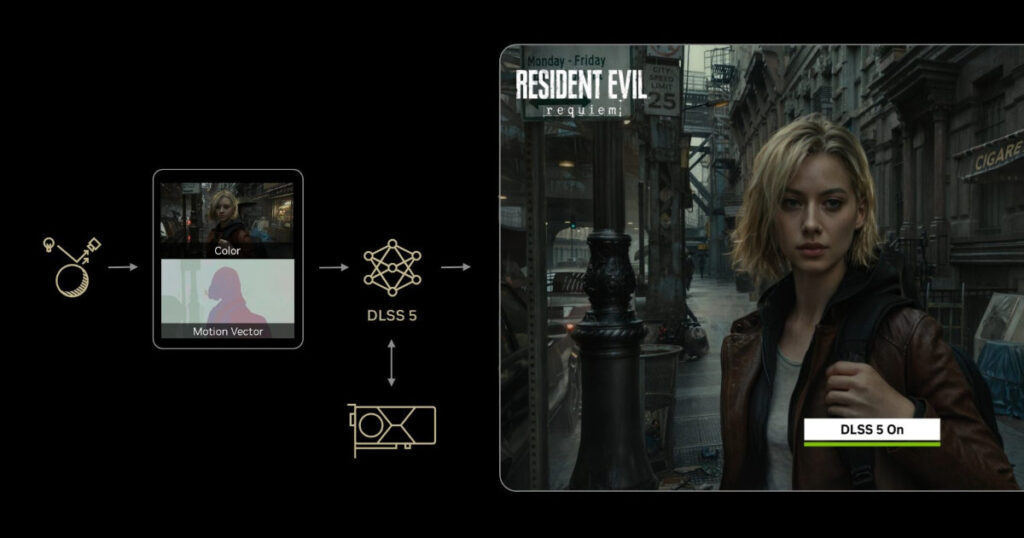
Think of it this way: traditional rendering is like following a recipe precisely. Neural rendering is like having a chef who has tasted thousands of dishes and can improve any plate of food by knowing what it should look and taste like, without following a fixed recipe. DLSS 5 is the chef.
The AI model was trained end to end to understand scene semantics. This means it recognises what objects are in a scene (a face, a piece of cloth, a reflective surface) and applies appropriate material enhancements to each one. A metal sword gets different treatment from a human hand, even if both are illuminated by the same in-game light source.
The output runs in real time at up to 4K resolution and is designed to be consistent frame to frame. This temporal stability is a core requirement for games, where flickering or inconsistent image quality is immediately visible and disruptive.
What NVIDIA DLSS 5 Is Not: Three Common Misconceptions
Because DLSS 5 carries the same name as previous versions, it is easy to conflate it with technologies you might already know. Here are three things DLSS 5 is not.
It Is Not Upscaling
DLSS Super Resolution, the feature most people associate with ‘DLSS’, renders a game at a lower internal resolution (such as 1080p) and then uses AI to reconstruct a higher-resolution output (such as 4K). This saves GPU resources while maintaining image quality. DLSS 5 does not replace this function. DLSS Super Resolution continues to exist and be relevant. DLSS 5 is a separate visual enhancement layer that works on top of the already rendered frame.
It Is Not Frame Generation
DLSS 3 introduced Frame Generation, which creates entirely new frames between the frames your GPU renders. DLSS 4.5 pushed this further with Multi Frame Generation, which NVIDIA says generates 23 out of every 24 pixels you see on screen. These features are about frame rate. DLSS 5 is about visual quality. The two operate separately. A game can run DLSS 5 alongside DLSS Super Resolution and Frame Generation at the same time.
It Is Not a Replacement for DLSS 4.5
DLSS 5 adds a new capability to the DLSS suite. It does not remove or replace DLSS 4.5 features. You will not have to choose between DLSS 5 and the existing performance features. NVIDIA says integration uses the same Streamline framework as existing DLSS technologies, meaning developers who already support DLSS should find it easier to add DLSS 5 support.
DLSS Version History: Why DLSS 5 Is a Different Kind of Upgrade
Each major DLSS version introduced a different approach to AI-assisted graphics. This table shows the progression and makes clear why DLSS 5 is a bigger architectural shift than the steps between versions 1, 2, 3, and 4.
| Version | Year | Technology | What It Added | Category |
| DLSS 1 | 2018 | CNN model (convolutional neural network) | AI upscaling from lower resolution to higher resolution | Performance (resolution upscaling) |
| DLSS 2 | 2020 | Improved CNN, general model (no per-game training) | Better upscaling quality, worked across more games without custom training per title | Performance (resolution upscaling) |
| DLSS 3 | 2022 | Optical Flow Accelerator, Frame Generation | AI-generated intermediate frames to boost frame rate | Performance (frame rate) |
| DLSS 3.5 | 2023 | Ray Reconstruction | AI denoising for ray tracing, replacing traditional denoisers | Quality (ray tracing improvement) |
| DLSS 4 / 4.5 | 2025 to 2026 | Transformer model, Multi Frame Generation | Up to 6x frame generation (23/24 pixels AI-generated), improved upscaling quality | Performance (frame rate + upscaling) |
| DLSS 5 | Fall 2026 | Real-time neural rendering model | Photoreal lighting, material detail, skin, fabric, hair enhancement applied to rendered frames | Quality (visual fidelity and photorealism) |
The key distinction is in the final column. DLSS 1 through 4.5 were primarily performance technologies: they helped GPUs produce more frames or better-looking frames without extra native rendering cost. DLSS 5 is primarily a quality technology. It takes what is already rendered and makes it look better. It is the first major DLSS version not focused on frame rate.
Developer Controls: How Game Artists Can Shape the Result
One of the important aspects of DLSS 5 is that NVIDIA has built control tools into the technology for game developers. This is meant to address the concern that a neural rendering model could override a game’s intentional art style.
Intensity Control
Developers can set how strongly DLSS 5 enhances the image. A game with a stylised or cartoonish art style might use lower intensity so the enhancements are subtle and do not push the game toward photorealism the developers did not intend. A game trying to be as realistic as possible might use higher intensity.
Colour Grading
Many games use specific colour palettes or tones as part of their identity. A horror game might be desaturated and cold. A tropical adventure might be warm and saturated. DLSS 5 includes colour grading controls that let developers maintain their game’s colour identity even after neural enhancements are applied. The controls adjust contrast, saturation, and gamma to match the original look.
Masking
This is one of the most practically useful controls. Masking lets developers tell DLSS 5 to leave specific objects or areas of the screen completely unchanged. If a character has a distinctive stylised face that the developer wants to keep exactly as designed, they can mask that element. DLSS 5 will skip it and only enhance the parts of the frame the developer specifies.
Together, these controls are NVIDIA’s argument that DLSS 5 is a tool for artists rather than an override. Whether developers use these controls effectively will vary. The technology gives them the capability; the results will depend on how each game studio chooses to implement it.
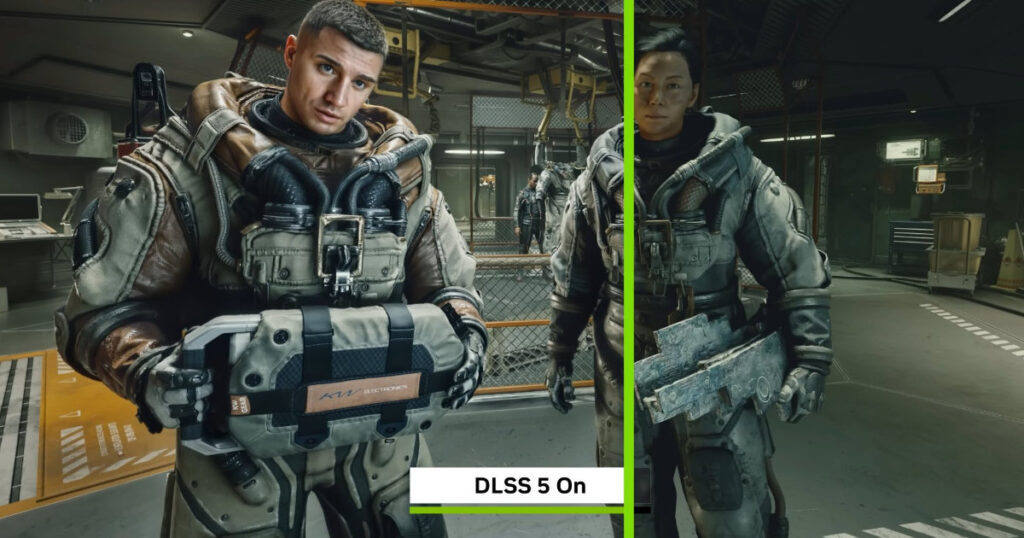
Todd Howard, studio head and executive producer at Bethesda Game Studios, is excited for DLSS 5 – bringing photorealistic lighting and materials to Starfield. pic.twitter.com/NQF9twyNfs
— NVIDIA GeForce (@NVIDIAGeForce) March 16, 2026
The Dual RTX 5090 Demo: What It Means for Single-Card Users
At GTC 2026, NVIDIA ran its DLSS 5 demonstration using two RTX 5090 GPUs working together. One GPU ran the game itself (including path tracing). The second GPU ran DLSS 5 exclusively. Digital Foundry, which had access to the demo ahead of the keynote, confirmed this setup.
This immediately raised questions about how practical DLSS 5 will be for everyday users when it launches this fall.
Why Two GPUs Were Used
The demo was running demanding games with full path tracing enabled, which is extremely GPU-intensive on its own. NVIDIA used the second RTX 5090 specifically to separate the DLSS 5 workload from the game rendering workload, allowing both to run at maximum quality simultaneously without VRAM or compute bottlenecks.
This was a demonstration of the technology’s potential quality ceiling, not a representation of how it will ship. NVIDIA has confirmed that DLSS 5 will run on a single RTX 50-series GPU at launch. The demo was a showcase, not a product spec.
What This Tells Us Honestly
The dual-GPU demo does reveal that DLSS 5 is computationally demanding in its current form. NVIDIA is actively optimising the technology before the Fall 2026 launch. What remains unknown at this point is the exact performance cost of running DLSS 5 on a single card. NVIDIA has not yet published frame-time or VRAM cost data for single-card usage. These numbers will matter enormously for buyers deciding whether DLSS 5 is practically usable in their games.
It is reasonable to expect that a single RTX 5090 will handle DLSS 5 comfortably. Whether a lower-tier RTX 5070 or RTX 5060 can run it without significant overhead is an open question that will be answered when real benchmarks become available closer to launch.
Which GPUs Support DLSS 5?
NVIDIA has confirmed that DLSS 5 will launch with RTX 50-series GPU support. This covers the Blackwell architecture cards: RTX 5090, RTX 5080, RTX 5070 Ti, RTX 5070, and RTX 5060.
What About Older RTX Cards?
As of the GTC 2026 announcement, NVIDIA has not confirmed DLSS 5 support for RTX 30 or RTX 40 series cards. This is different from DLSS 4.5, which extended some features (such as the improved Transformer model for Super Resolution) to older RTX generations.
DLSS 5 is a neural rendering model that likely requires the Tensor Core capabilities specific to Blackwell (RTX 50) architecture. NVIDIA has positioned DLSS 5 as a premium feature for the current generation. If older card support is planned, NVIDIA has not announced it.
Context for OC3D’s Claim That It Does Not Require New Hardware
OC3D’s coverage stated that DLSS 5 does not require new hardware and will run on ‘today’s GPUs’. This referred to the fact that DLSS 5 was demonstrated running on RTX 50 hardware, which was released in late 2024 and early 2025 and is the current generation. The OC3D phrasing was meant to distinguish DLSS 5 from a hypothetical future GPU requirement, not to suggest compatibility with RTX 20, 30, or 40 series cards.
If you own an RTX 30 or RTX 40 series card, the clear and current answer is that DLSS 5 has not been confirmed for your GPU.
Games Confirmed to Support NVIDIA DLSS 5
NVIDIA announced a list of games and publishers that will integrate DLSS 5. The list includes both upcoming releases that will launch with DLSS 5 support and existing games that will receive DLSS 5 via updates.
| Game Title | Publisher / Developer | New Release or Retrofit? |
| Resident Evil Requiem | Capcom | New release (2026) |
| Starfield | Bethesda Game Studios | Retrofit update for existing game |
| Hogwarts Legacy | Avalanche Software / WB Games | Retrofit update for existing game |
| Assassin’s Creed Shadows | Ubisoft | Retrofit update for existing game |
| The Elder Scrolls IV: Oblivion Remastered | Bethesda / Virtuos | New release (2025, DLSS 5 update) |
| Phantom Blade Zero | S-GAME | New release (upcoming) |
| Black State | Unknown | New release (upcoming) |
| AION 2 | NCSOFT | New release |
| Delta Force | TiMi Studio Group / Tencent | Retrofit update |
| NARAKA: BLADEPOINT | NetEase | Retrofit update |
| Where Winds Meet | Everstone Studio | New release (upcoming) |
| NTE: Neverness to Everness | Hotta Studio | New release (upcoming) |
| Sea of Remnants | Unknown | New release (upcoming) |
| Justice | NetEase | Retrofit update |
| CINDER CITY | Unknown | New release (upcoming) |
The retrofits for existing games like Starfield, Hogwarts Legacy, and Assassin’s Creed Shadows are significant. They mean players who own these games will be able to see DLSS 5 in action without buying new titles. This also makes it easier for the industry to form early opinions about the technology’s real-world impact.
The Honest Concerns: What Sceptics Are Saying About NVIDIA DLSS 5
Early reactions to DLSS 5 are split between excitement about the technology’s potential and genuine concerns about what was shown in the demo. Both reactions are worth taking seriously.
The ‘AI Filter’ Criticism
PC Gamer’s early coverage described DLSS 5 as looking like a pretty AI lighting filter. Tom’s Hardware commenters noted that some of the enhanced images look overly processed, with faces and skin appearing unnaturally smooth in a way that reminds viewers of generative AI images rather than natural-looking game characters.
This is a legitimate concern. Neural rendering models trained on photorealistic data can push images toward a certain homogeneous look, particularly on human faces. The concern is that DLSS 5 could make characters from different games look increasingly similar rather than preserving each game’s distinct visual identity.
The Artistic Intent Question
The most substantive concern raised, particularly by 80 Level and PC Gamer, is whether DLSS 5 respects the artistic decisions of game developers. A game’s lighting, material texture, and visual tone are deliberate artistic choices. If DLSS 5 overrides these automatically, the result is a game that looks different from what the studio intended.
NVIDIA’s developer control tools (intensity, colour grading, masking) are the answer to this concern. The question is whether all studios will invest the time to use them carefully. For games with large, well-resourced development teams like Capcom and Bethesda, careful integration is likely. For smaller studios or developers adding DLSS 5 support quickly, the defaults might run without fine-tuning.
The Unknown Performance Cost
No independent performance data is available for DLSS 5 on a single card. NVIDIA has not published VRAM usage or frame-time overhead data. The fact that the GTC demo needed two RTX 5090s is a data point, not a verdict, but it does mean the performance question is genuinely open until benchmarks arrive.
The Balanced View
Digital Foundry, which had pre-announcement access to DLSS 5 and has consistently been one of the most technically precise publications covering GPU technology, described the material handling as capable of being astonishing and noted that DLSS 5 is consistent and coherent in how it processes the game world. Their early assessment is more positive than the GTC demo screenshots suggest, which indicates the technology may perform better in motion and in person than in compressed online video comparisons.
The technology is also five to six months from launch as of this announcement. What NVIDIA showed at GTC is an early demonstration, not a final product. The honest position is to reserve judgment until independent reviewers have access to shipping hardware and software.
Summary: What NVIDIA DLSS 5 Means and What to Do Right Now
Here is a clear summary of everything confirmed about DLSS 5 as of the GTC 2026 announcement.
- What it is: a real-time neural rendering model that adds photoreal lighting and material detail to game frames. It is a visual quality technology, not a performance technology.
- What it is not: upscaling, frame generation, or a replacement for DLSS 4.5. It works alongside existing DLSS features.
- When it launches: Fall 2026.
- Which GPUs: RTX 50-series confirmed. Older GPU support not announced.
- Which games: 16 confirmed titles including Resident Evil Requiem, Starfield, Hogwarts Legacy, and Assassin’s Creed Shadows. More expected before launch.
- The demo used two RTX 5090s: single-card use is confirmed for launch but performance data for single-card use has not been published.
- Developer controls: intensity, colour grading, and masking tools allow studios to control how DLSS 5 enhancements are applied.
- Legitimate concerns: artistic fidelity, unknown performance cost, and early demo quality that impressed some viewers and concerned others.
What to Do Right Now
If you own an RTX 50-series GPU and want to try DLSS 5 when it launches in fall, check that the games you play are on the confirmed list. Hogwarts Legacy and Starfield are strong early options for seeing the technology in existing games you may already own.
If you own an RTX 40-series or older GPU, watch for any announcements from NVIDIA about broader support. As of March 2026, none has been confirmed.
If you are considering buying an RTX 50-series GPU, DLSS 5 is one more capability to factor into the decision, but not the only one. DLSS 4.5 with Multi Frame Generation is already available and functional. DLSS 5 in fall will be an additional reason to own a current-generation card.






[…] just pulled back the curtain on DLSS 5 at GTC 2026, and the reaction has been anything but quiet. Jensen Huang, founder and CEO of Nvidia, called it […]
[…] Nvidia CEO Jensen Huang told podcaster Lex Fridman on Monday, March 23, 2026: “I think we’ve achieved AGI.” Within hours, the clip was circulating on every tech platform. By Tuesday morning it was trending in India. And like almost every major AI headline in the past two years, it is simultaneously more interesting and less definitive than the headline makes it sound. […]
[…] and modern automation, Panic has confirmed that it will no longer accept games featuring generative AI for its official “Catalog” store. This decision marks a significant moment for the platform, which has […]