
READ THIS before you buy the AirPods Max 2

Apple announced the AirPods Max 2 on March 16, 2026, with zero leaks beforehand. Five years after the original, this is the first real upgrade to Apple’s premium headphones. H2 chip, 1.5x better ANC, new smart features, and a new creator toolkit at the same $549 price. Here is everything you need to know.
AirPods Max 2: Everything That Is New
Apple kept the AirPods Max 2 completely secret before announcing it today via a press release on the Apple Newsroom. No leaks, no rumours, no previews. That makes this one of the rarest Apple launches in recent memory.
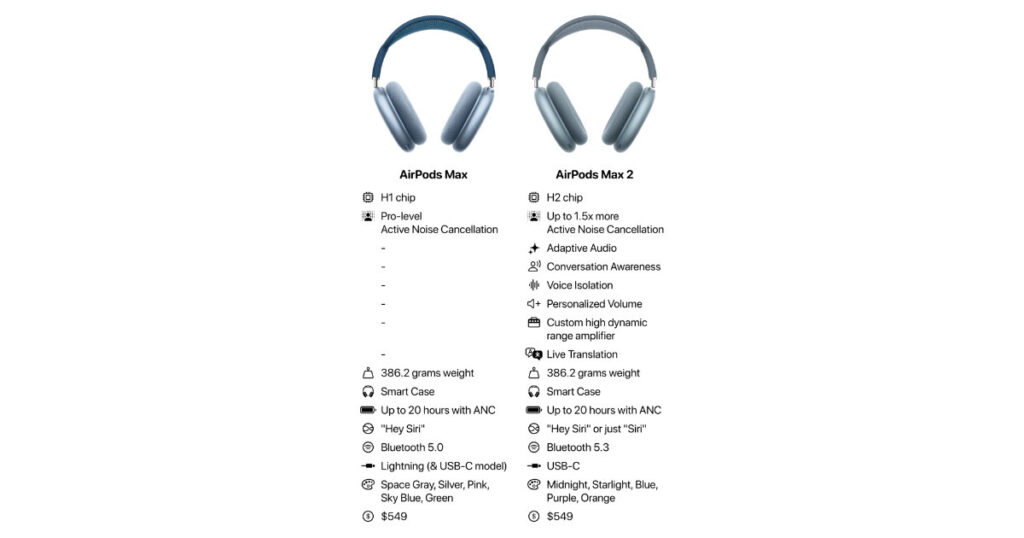
The biggest change is the move from the H1 chip to the H2 chip. The H2 has been in the AirPods Pro 2 since 2022 and in the AirPods 4 since 2024. Its arrival in the AirPods Max is overdue by most measures, and it brings a substantial set of improvements. Here is the full list of what is new:
- H2 chip: replaces the H1 chip from 2020. Enables all the smart features below and powers 1.5x more effective ANC.
- 5x more effective Active Noise Cancellation: Apple’s own claim. Blocks more environmental noise, specifically mentioning airplane engines and commuter trains.
- New high dynamic range amplifier: a hardware component that produces cleaner audio output with less distortion at all volume levels.
- Improved Transparency mode: uses a new digital signal processing algorithm built for H2 to make the outside world sound more natural when Transparency is on.
- Adaptive Audio: automatically blends ANC and Transparency depending on your surroundings. New to AirPods Max.
- Conversation Awareness: automatically lowers your audio and reduces background noise when you start speaking. New to AirPods Max.
- Personalized Volume: adjusts volume based on your environment and listening preferences over time. New to AirPods Max.
- Voice Isolation: prioritises your voice during calls and blocks ambient noise. New to AirPods Max.
- Live Translation: powered by Apple Intelligence, translates conversations between languages in real time. New to AirPods Max.
- Siri head gestures: nod yes or shake no to respond to Siri announcements. New to AirPods Max.
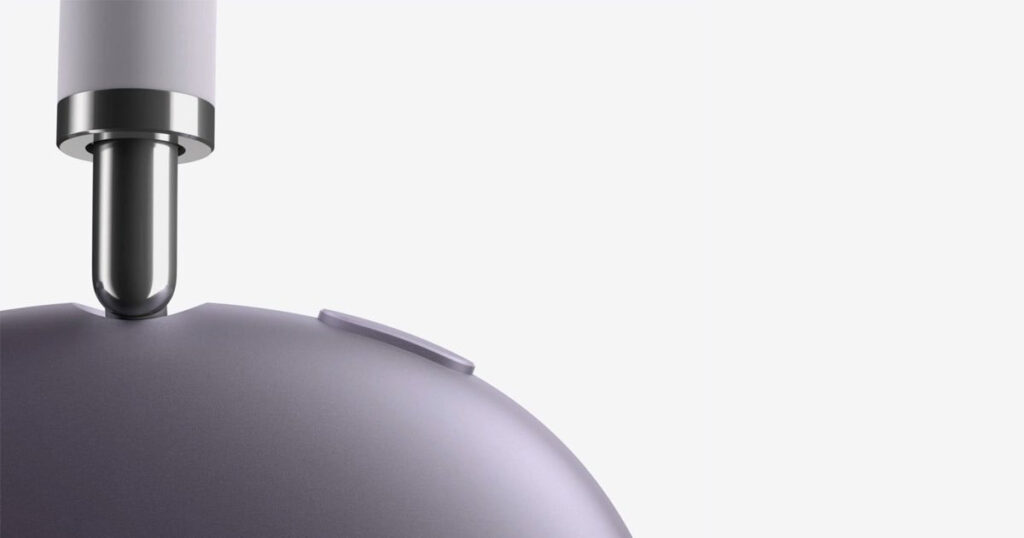
- Camera Remote: press the Digital Crown to take a photo or start and stop video on an iPhone or iPad. New to AirPods Max.
- Studio-quality audio recording: record audio using the AirPods Max 2 microphones at studio quality for podcasting, music, and content creation.
- Improved Spatial Audio: better instrument localisation, more accurate bass response, and more natural mids and highs.
- Bluetooth 5.3: upgraded from Bluetooth 5.0 in the original. More stable connection and reduced wireless audio latency for gaming.
- Reduced wireless audio latency: improved for gaming, especially in Game Mode on iOS, macOS, and iPadOS.
The H2 Chip: What It Actually Does and Why It Matters
The H2 chip is the heart of everything that is new in the AirPods Max 2. If you want to understand why this upgrade feels significant after five years of waiting, the chip is the reason.
What Computational Audio Means
Traditional headphones use hardware circuits to filter sound. The components are fixed. What you get from day one is what you get forever. Apple’s approach is different. The H2 chip runs software algorithms in real time to process audio. This is what Apple calls computational audio.
Instead of fixed circuits, the AirPods Max 2 runs a continuous loop: the microphones outside and inside the ear cups sample what you and the world around you sound like thousands of times per second, the H2 chip analyses that data, and the audio you hear is adjusted on the fly based on what the chip has calculated. Better chip means faster analysis, more processing headroom, and better results from the same microphone hardware.
H1 vs H2: The Practical Difference
The original AirPods Max used an H1 chip in each ear cup (two H1 chips total). The H2 delivers more processing power per chip and, critically, supports a different generation of algorithms. Several features simply could not run on H1: Adaptive Audio, Conversation Awareness, Personalized Volume, Voice Isolation, Live Translation, and the improved ANC algorithm. These are not features Apple chose to withhold from H1. They require more computational power than H1 can deliver.
Think of H1 as a calculator and H2 as a small laptop. The calculator does basic maths well. The laptop does everything the calculator does plus runs software that the calculator cannot handle. Switching to H2 does not just make the headphones faster. It unlocks an entirely different category of what the headphones can do.
The New Smart Features: What Each One Does in Real Life
Adaptive Audio
Adaptive Audio automatically decides how much of the outside world you should hear based on what is happening around you. If you are walking down a busy street, it blends more Transparency in so you can hear traffic. If you step into a quiet office, it shifts toward more ANC. You do not have to manually switch between modes. The transition happens in the background without interrupting your audio.
This is particularly useful in environments that change rapidly, like commuting: underground (more ANC), above ground at a busy station (more Transparency), and inside a train carriage (blend). Instead of managing these transitions manually, Adaptive Audio handles them.
Conversation Awareness
When you start talking to someone, Conversation Awareness detects your voice and automatically lowers your audio volume and reduces background noise from the outside. When you stop speaking, the audio returns to normal. You do not need to take the headphones off or pause your music manually to have a conversation.
The practical benefit is meaningful for anyone who has a lot of quick conversations throughout the day, such as in an office, a coffee shop, or while shopping. The response is fast enough that it does not feel laggy, and the return to full volume after speaking is gradual enough to not feel jarring.
Live Translation
Live Translation uses Apple Intelligence to translate speech between languages in real time. When two people are speaking different languages, the AirPods Max 2 translates what each person says so both can follow the conversation.
This requires an iPhone with Apple Intelligence support. Live Translation works best in relatively quiet environments and with clear speech. It is not a replacement for a professional interpreter in formal settings, but for everyday conversations with someone who speaks a different language, it is a genuinely practical tool.
Siri Head Gestures
When Siri makes an announcement such as an incoming call or a notification you can respond to, you can now nod your head yes or shake your head no instead of speaking. The AirPods Max 2 detect the head movement and respond accordingly. This is a small quality-of-life feature but a useful one in situations where speaking out loud is not appropriate.
Camera Remote, Studio Recording, and the Creator Toolkit
The AirPods Max 2 introduce a meaningful set of creator-focused features that were absent from the original. These are worth understanding if you use your headphones for content creation, music production, or podcasting.
Camera Remote
By pressing the Digital Crown on the AirPods Max 2, you can trigger the camera shutter on a nearby iPhone or iPad, or start and stop video recording. This works with Apple’s native Camera app and compatible third-party camera apps.
The practical use is clear: set your iPhone on a tripod, put your AirPods Max on, and start filming without needing to reach for the screen. For vloggers, interview hosts, or anyone recording themselves, this removes a recurring friction point.
Camera Remote requires an iPhone or iPad. It does not work with a Mac or standalone camera. Third-party app support will depend on the developer implementing the compatible API. Check before relying on it with a specific app.
Studio-Quality Audio Recording
The AirPods Max 2 now let you record audio using the headphone microphones at studio quality. Combined with the USB-C lossless connection and Logic Pro, this creates a workflow where a musician or podcaster can hear their session in 24-bit lossless audio while simultaneously recording through the same headphones.
Logic Pro and Personalized Spatial Audio
Apple claims that the AirPods Max 2 are the only headphones that let musicians both create and mix using Personalized Spatial Audio with head tracking on Logic Pro. Personalized Spatial Audio uses your individual ear shape, measured by your iPhone’s Face ID camera, to create a spatial audio profile that is calibrated specifically for you rather than a generic average.
When you move your head while mixing in Logic Pro, the spatial audio field stays anchored to the sound source as if the speakers are in fixed positions in the room. For music mixing, this means a more accurate sense of where each element in the mix sits spatially. This is a genuinely unique claim for $549 headphones and has real value for producers working primarily within the Apple ecosystem.
What Did Not Change: The Honest List
Every Apple launch article focuses on what is new. Buyers also need to know what stayed the same, especially at $549. Here is the complete list of what the AirPods Max 2 did not change.
| Feature | Status | What It Means for Buyers |
| Battery life | Unchanged: 20 hours ANC on | Still behind Sony (37h) and Bose QC Ultra (24h). At $549 in 2026, this stands out as the clearest competitive weakness. |
| Design | Unchanged: same frame, mesh, ear cushions | If you found the original comfortable, Gen 2 will feel identical. If you disliked the weight or non-folding build, Gen 2 does not address this. |
| Weight | Approximately 386g (no official update) | Remains one of the heavier options in the premium segment. Ming-Chi Kuo’s leaked prediction of a lighter build did not materialise in this generation. |
| Wireless lossless audio | Not supported over Bluetooth | Lossless audio requires the USB-C cable. Bluetooth still uses AAC. Sony’s LDAC and aptX Lossless offer better wireless quality on competing headphones. |
| Water resistance | No official IP rating | The AirPods Max 2 have no certified water or sweat resistance rating. This is unusual for $549 headphones in 2026. |
| Folding design | Non-folding, same as Gen 1 | Does not fold for travel. Requires the same Smart Case (unchanged) which provides minimal protection. |
| Smart Case | Unchanged: same open-bottom design | The Smart Case still does not fully enclose the headphones. Widely criticised since 2020 and not addressed in Gen 2. |
| USB-C lossless audio | Same as updated Gen 1 (24-bit/48kHz via USB-C cable) | The original AirPods Max (USB-C version) already had this via a March 2025 firmware update. This is not a Gen 2 exclusive. |
| Colours | Midnight, Starlight, Orange, Purple, Blue (same as USB-C Gen 1) | Same five colours as the 2024 USB-C model. No new colour options. |
| Price | $549 US / £499 UK / $799 CAD | Same as Gen 1 launch price. Apple held pricing despite five years of inflation and component cost changes. |
The battery life is the most significant gap. Sony’s WH-1000XM6 offers 37 hours with ANC. Bose QuietComfort Ultra offers 24 hours. At $549, a 20-hour battery was competitive in 2020. In 2026 it is the clear weak point of an otherwise strong upgrade.
AirPods Max Gen 1 vs Gen 2: Full Spec Comparison
| Spec / Feature | Gen 1 (original H1) | Gen 2 (H2, 2026) | Changed? |
| Chip | H1 (one per ear cup) | H2 | Yes |
| ANC effectiveness | Baseline | Up to 1.5x better | Yes |
| Transparency mode | Standard | New H2 DSP algorithm, more natural | Yes |
| Adaptive Audio | Not available | Available | New feature |
| Conversation Awareness | Not available | Available | New feature |
| Personalized Volume | Not available | Available | New feature |
| Voice Isolation | Not available | Available | New feature |
| Live Translation | Not available | Available (Apple Intelligence) | New feature |
| Siri head gestures | Not available | Available | New feature |
| Camera Remote | Not available | Available (iPhone/iPad) | New feature |
| HDR amplifier | Standard amplifier | New HDR amplifier | Yes |
| Bluetooth | 5.0 | 5.3 | Yes |
| USB-C lossless (24bit/48kHz) | Yes (via March 2025 firmware) | Yes | Same |
| Battery life (ANC on) | 20 hours | 20 hours | Unchanged |
| Wireless lossless | No | No | Unchanged |
| Water resistance | No IP rating | No IP rating | Unchanged |
| Design / weight | Fixed, ~386g | Fixed, ~386g | Unchanged |
| Smart Case | Open-bottom design | Open-bottom design | Unchanged |
| Price | $549 | $549 | Same |
AirPods Max 2 vs Sony WH-1000XM6 and Bose QuietComfort Ultra
At $549, the AirPods Max 2 competes with the best premium headphones from Sony and Bose. Here is how they compare on the factors that matter most to buyers at this price.
| AirPods Max 2 | Sony WH-1000XM6 | Bose QC Ultra | |
| ANC quality | 1.5x better than Gen 1, H2-powered | Industry-leading class, LDAC-enabled | Best-in-class Bose ANC |
| Battery life (ANC on) | 20 hours | 37 hours | 24 hours |
| Wireless lossless | No (AAC only) | Yes (LDAC) | No (AAC only) |
| Wired lossless | 24-bit/48kHz USB-C | 3.5mm analog | 3.5mm analog |
| Water resistance | No IP rating | IPX4 | IPX4 |
| Folding design | No | Yes | Yes |
| Platform | Best on Apple, works on Android | Android + iOS, full feature on both | Android + iOS, full feature on both |
| Smart features | Adaptive Audio, Live Translation, Siri head gestures (Apple ecosystem only) | Speak-to-chat, quick-pair, Sony app features | Immersive Audio, Aware Mode, Bose app |
| Creator tools | Camera Remote, Logic Pro spatial audio, studio recording | None | None |
| Price | $549 | ~$399 to $449 | ~$429 |
The AirPods Max 2 wins on deep Apple ecosystem integration, creator features, and spatial audio quality for Apple users. Sony WH-1000XM6 wins on battery life, wireless lossless, value, and platform flexibility. Bose QC Ultra is the best choice for platform-agnostic buyers who prioritise ANC quality and portability. If you live in the Apple ecosystem and use iPhone, iPad, and Mac every day, the AirPods Max 2 is hard to beat. If you use Android, Windows, or mixed platforms, Sony and Bose offer more for less money.
Price, Availability, and How to Order
The AirPods Max 2 are priced at $549 in the United States, £499 in the United Kingdom, and $799 in Canada. Apple is no longer selling the original AirPods Max alongside the new model.
Pre-orders open on Wednesday, March 25, 2026 on Apple.com and in the Apple Store app in the United States and more than 30 countries. In-store availability and shipping begin in early April.
The AirPods Max 2 are available in five colours: Midnight, Starlight, Orange, Purple, and Blue. These are the same five colours introduced with the USB-C AirPods Max in September 2024. No new colour options were added.
AppleCare+ is available as monthly or annual subscription. Apple offers free engraving with a mix of emoji, names, initials, and numbers when purchased directly from Apple without affecting the estimated delivery time.
If you are considering the AirPods Max 2 as your first pair of AirPods Max, it is worth noting that no meaningful hands-on reviews will be available before pre-orders open on March 25. This is an unusually short window between announcement and order-open. You can pre-order on March 25 and cancel if early reviews raise concerns, or wait for independent reviews in early April before committing.
Who Should Buy the AirPods Max 2 and Who Should Not
Buy the AirPods Max 2 if
- You are a deep Apple ecosystem user. The smart features, Live Translation, Logic Pro integration, Camera Remote, and Siri head gestures all work best or exclusively on iPhone, iPad, and Mac. If Apple devices are your daily tools, the AirPods Max 2 gives you capabilities that no competing headphone offers.
- You are a content creator or musician working in the Apple ecosystem. The Camera Remote, studio recording, and Logic Pro + Personalized Spatial Audio combination is unique to AirPods Max 2 among $549 headphones. These features have real value in a music production or content workflow.
- You want the best available ANC quality without caring about battery life comparison. The H2-powered 1.5x ANC improvement is a real and meaningful upgrade. For commuters and frequent flyers where blocking noise is the primary purpose, the AirPods Max 2 will deliver excellent results.
- You are buying your first AirPods Max. At the same $549 price as the original, you get significantly more technology than Gen 1 offered at launch. For first-time buyers, the choice is straightforward.
Look elsewhere if
- Battery life is a priority. Twenty hours of ANC-on battery in 2026 is below the competition. Sony’s WH-1000XM6 at $399 to $449 offers 37 hours. If you need to go a full international flight and then some on a single charge, the AirPods Max 2 will not make it.
- You want wireless lossless audio. The AirPods Max 2 support lossless only over USB-C. If you want lossless wirelessly, Sony’s LDAC supports it and is available on the WH-1000XM6.
- You use Android or Windows as your primary devices. The AirPods Max 2 will connect to Android and Windows via Bluetooth, but most smart features require Apple devices. You would be paying $549 for headphones that function at a basic level on non-Apple platforms.
- You need a practical travel companion. The non-folding design, the unchanged Smart Case, and the lack of water resistance make the AirPods Max 2 less practical for travel and commuting in variable conditions compared to Sony and Bose alternatives that fold and carry an IPX4 rating.
- You own the original AirPods Max and primarily care about audio quality. The wired lossless audio and core audio quality were already available to Gen 1 owners via firmware updates. The genuine upgrades are the smart features, ANC improvement, and creator tools. If none of those are important to you, Gen 1 remains a strong product.
The AirPods Max 2 is the upgrade Apple AirPods Max owners have been waiting for since 2022. The H2 chip closes a significant gap with the AirPods Pro in terms of features and ANC quality. At $549 with the same price as Gen 1, it is a stronger value than any previous version of AirPods Max. The persistent weaknesses (20-hour battery, no wireless lossless, no IP rating, no folding design) are real and matter more at $549 than they did at launch in 2020 when the competition was less formidable. If you live in the Apple ecosystem, the AirPods Max 2 is the best over-ear headphone for your setup. If you do not, Sony and Bose offer more capability per dollar.





[…] is a fundamentally different technology from true MicroLED. The MicroLED has no LCD panel at all. Each pixel generates its own light, similar to OLED but without the risk of burn-in and with much higher brightness […]
[…] the historic introduction of the 501 Loose to the plant-based engineering behind Performance Cool, every decision in this collection connects a deep respect for […]
[…] dedicated Trent 1000 XE facilities in the UK, Singapore and Germany. This is further supported by a significant expansion of its global spare engine pool, ensuring fleet availability and protecting airlines against unplanned operational […]
[…] AirPods 5 launch is here, and it changes what you get for the least amount of money in Apple’s earbuds lineup. Until now, if you wanted noise cancellation from Apple, you had to pay for the AirPods Pro or the […]