
Nvidia DLSS 5 games list: every confirmed title, how it works, and what to expect this fall

Nvidia just pulled back the curtain on DLSS 5 at GTC 2026, and the reaction has been anything but quiet. Jensen Huang, founder and CEO of Nvidia, called it the company’s most significant breakthrough in computer graphics since the debut of real-time ray tracing in 2018. While some reviewers who got an early look called it transformative. A large chunk of the internet called it something far less flattering.
Whether you are excited, skeptical, or just trying to figure out what is actually changing, here is everything known so far about Nvidia DLSS 5 games, how the tech works under the hood, which GPU you will need, and the real questions that still do not have answers yet.
What is Nvidia DLSS 5, and how is it different from DLSS 4.5?
Before anything else, it helps to understand what DLSS has been up to this point.
Nvidia DLSS was released in 2018 as an AI technology to boost performance, first by upscaling resolution, then by generating entirely new frames. Over time it has been integrated into over 750 games and become a gold standard for the industry. DLSS 4.5, launched at CES 2026, uses AI to draw 23 out of every 24 pixels seen on screen.
DLSS 5 is a different kind of step. Rather than upscaling or generating frames, it introduces a real-time neural rendering model that infuses pixels with photoreal lighting and materials, bridging the divide between game rendering and reality.
The practical distinction matters. Every version of DLSS before this has worked on the image after the game engine finishes rendering it. DLSS 5 works differently. It takes the engine’s render buffers, including colour, depth, normals, motion vectors, and material IDs, and passes them through a neural network with three sub-systems: a semantic and material classifier, a lighting estimator, and a neural shading compositor. These work together to apply physically-informed shading behaviours, including subsurface scattering on skin, anisotropic highlights on hair, and correct material response for glass and metal, without the game engine needing to calculate any of this explicitly.
In plain language: DLSS 4.5 cleaned up an image and added frames. DLSS 5 looks at a scene, understands what is in it, and then re-renders how light and materials should behave. It is closer to what a VFX studio does for a film, except it happens in real time at up to 4K.
The rendering horsepower available to a 16-millisecond game frame is a tiny fraction of what is available to a photoreal Hollywood VFX frame, which can take minutes to hours to render. Real-time rendering cannot bridge that gap through brute force alone. DLSS 5 is Nvidia’s answer to that problem.
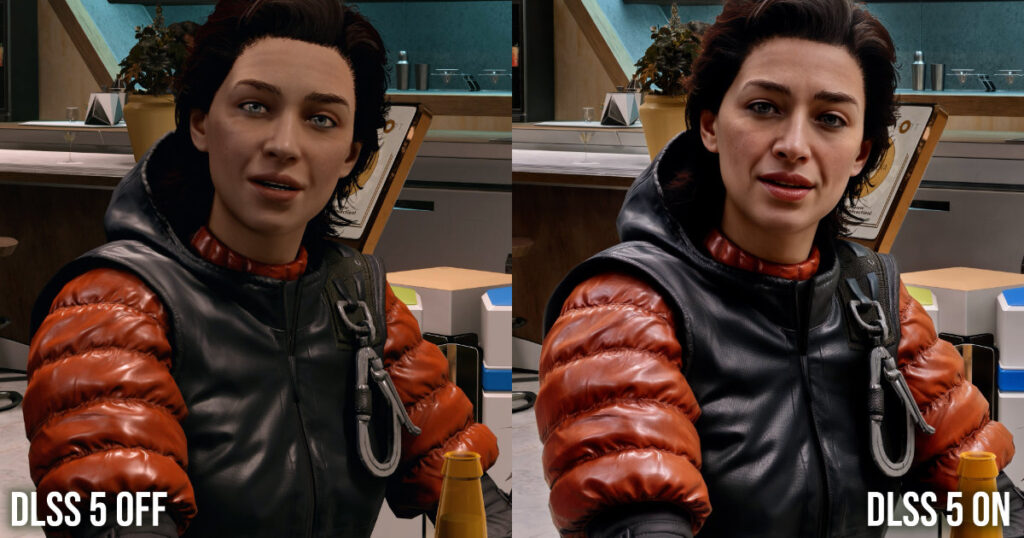
Every confirmed Nvidia DLSS 5 game so far
DLSS 5 will come to the following games: AION 2, Assassin’s Creed Shadows, Black State, CINDER CITY, Delta Force, Hogwarts Legacy, Justice, NARAKA: BLADEPOINT, NTE: Neverness to Everness, Phantom Blade Zero, Resident Evil Requiem, Sea of Remnants, Starfield, The Elder Scrolls IV: Oblivion Remastered, Where Winds Meet, and more.
That list currently stands at 16 confirmed titles, with Nvidia indicating it will grow significantly in the months ahead as more developers integrate the SDK.
Here is the full confirmed list broken down by publisher:
| Game | Publisher / Developer |
|---|---|
| Starfield | Bethesda Game Studios |
| Resident Evil Requiem | Capcom |
| Assassin’s Creed Shadows | Ubisoft / Vantage Studios |
| Hogwarts Legacy | Warner Bros. Games |
| The Elder Scrolls IV: Oblivion Remastered | Bethesda |
| Delta Force | Team Jade / Tencent |
| NARAKA: BLADEPOINT | NetEase |
| Phantom Blade Zero | S-GAME |
| NTE: Neverness to Everness | Hotta Studio |
| AION 2 | NCSOFT |
| Justice | NetEase |
| Where Winds Meet | Unknown |
| Black State | Unknown |
| CINDER CITY | Unknown |
| Sea of Remnants | Unknown |
| More to be announced | Various |
Nvidia has emphasised this is a living list and will expand as publishers patch in support. Historically DLSS adoption has accelerated after early flagship titles demonstrate clear wins, with previous DLSS versions now appearing in hundreds of games across PC storefronts.
What the demos actually showed
At GTC 2026, Nvidia demonstrated DLSS 5 across several titles, including Assassin’s Creed Shadows, Starfield, Hogwarts Legacy, and the newly released Resident Evil Requiem.
Even in games that already feature real-time ray-traced effects like Hogwarts Legacy, switching DLSS 5 on creates more convincing lighting effects for environments and characters. Students standing in front of massive sunlit windows are rendered with convincing rim lighting around the edges of their hair and clothing that is absent with DLSS 5 turned off. Improved ambient occlusion better darkens every fold of students’ robes and every nook and corner of Hogwarts. Even everyday objects like couches look better situated in scenes thanks to more accurate shadows underneath.
In practice, DLSS 5 could mean denser global illumination in sprawling RPG hubs, smoother motion in combat scenes, or richer specular detail on metallic and wet surfaces. Studios that benefit most are those with large open worlds and complex lighting, such as Starfield’s space vistas or the atmospheric corridors of Resident Evil.
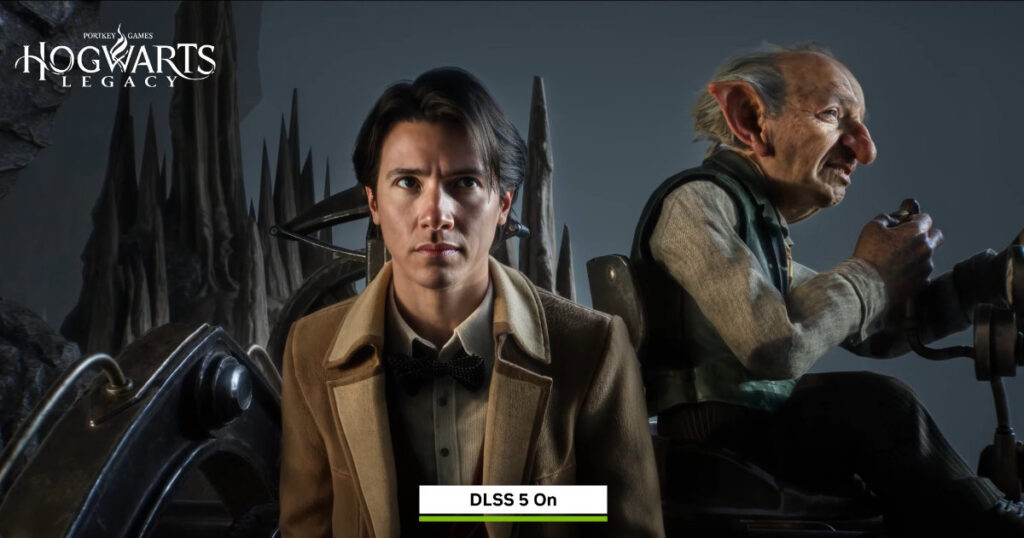
The Nvidia DLSS 5 controversy: AI beauty filters, art direction, and player backlash
The reaction to DLSS 5 has been sharp, and it is worth taking seriously rather than dismissing.
The DLSS 5 reveal has been described as one of the most controversial reveals of an Nvidia technology in recent memory. On one hand it has the potential to deliver a new level of photorealism into PC games this year, but on the other it has the more obvious potential to homogenise game graphics, and most especially characters, beyond developers’ and artists’ original intentions.
The specific flashpoint was the Resident Evil Requiem demo. Nvidia’s own Resident Evil Requiem sample drew attention for how a character’s face and the surrounding ambiance appeared to change with the feature enabled, raising questions about authorial intent. Critics described DLSS 5 as imposing AI-generated beauty standards onto characters that were deliberately designed to look a specific way.
DLSS 5 clearly overwrites game characters with AI beauty standards, but Nvidia says developers have “artistic control.”
Nvidia’s response to the criticism has been to point to developer controls. DLSS 5 provides game developers with detailed controls for intensity, colour grading, and masking, so artists can determine where and how enhancements are applied to maintain each game’s unique aesthetic.
DLSS 5 is optional in supported titles, and developers can expose toggles and presets to keep results within an intended look.
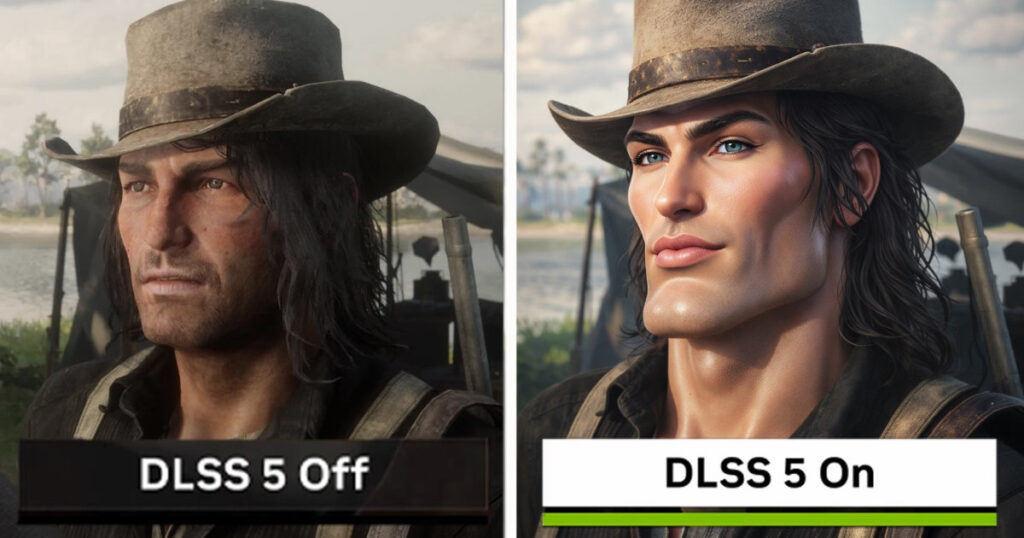
Whether those controls are granular enough to satisfy artists and players remains to be seen. Expect studios to collaborate closely with Nvidia’s developer relations teams and internal art leads to calibrate outputs. Outlets like Digital Foundry and PC-focused reviewers will pressure-test these modes at launch, helping players decide which settings respect the original art while delivering performance gains.
It is also worth flagging that on stage at GTC, the comparison appeared to pit DLSS 5 against no DLSS at all, leaving unclear how much improvement it offers over DLSS 4.5 with path tracing and all features enabled. The Nvidia DLSS 5 games list is still short, and the tech still needs significant optimisation work before it ships. But the underlying idea, replacing brute-force rendering calculations with an AI model that understands what a scene contains and re-lights it accordingly, is genuinely new territory. Whether it lands as a revolution or a controversial filter will depend almost entirely on how much control developers actually give players over the output. The fall 2026 launch will tell that story.







[…] is the simple version. Nvidia, the company that makes the chips most AI systems run on, wants to get closer to Reflection AI. […]