
Claude Opus 4.6 is OUT and here’s everything you need to know

Claude Opus 4.6 is officially here, and after putting it through a series of intense tests, I can honestly say the king might be back on the throne. Anthropic has just released this newly updated version of their most powerful model, and it brings some serious heat to the ongoing rivalry with OpenAI.
If you have been following the public drama between these two AI giants, you know how high the stakes are. This release is not just a minor tweak.
It is a significant step forward in how these models handle complex instructions and massive amounts of data.
Whether you are a hardcore developer or someone who just uses AI to help with daily tasks, there is a lot to unpack here. From adaptive thinking levels to a context window that can hold an entire library, this model is designed to work harder and smarter.
Let’s dive into what makes this Claude Opus 4.6 update special and see how it actually performs when you throw real world challenges at it.
The technical breakdown of the new update
One of the first things you will notice with this release is the move toward adaptive thinking. Previously, you usually had a binary choice between turning thinking on or off.
Now, we have four specific reasoning levels to choose from: low, medium, high, and max. This is a huge quality of life improvement because it allows you to scale the model’s brainpower based on the task.
If you are just asking a simple question, you don’t need it to spend minutes “meditating” on the answer.
Perhaps the most impressive technical stat is the 1 million token context window. This puts it in the elite class of models that can process massive documents or entire codebases in one go.
There is a catch, though. Premium pricing kicks in for prompts exceeding 200,000 tokens. You are looking at $10 per million input tokens and $37.50 per million output tokens for those massive tasks.
While that sounds pricey, the model also now supports 128,000 output tokens. This means it can complete huge coding tasks without you having to ask it to “continue” every five minutes.

Building an operating system in the browser
To see if the benchmarks actually translated to real performance, I started with a tried and true test. I asked the model to build a web browser based operating system from scratch.
It created something called NovOS, and the results were extremely competent. It included a functional clock, a start menu with eight applications, and even a working terminal that was not just a green on black aesthetic clone.
The special feature it implemented on its own was a “Glitch Mode” that distorted the UI, which was a fun touch. It also built a notepad application with a word count and character count feature.
What really impressed me was the ability to save notes directly to the local system as text files. It even handled classic games like Snake and Minesweeper with functional pause buttons and score tracking.
This level of zero shot consistency shows that the model’s logic is sharper than ever.
Action games and ship combat simulators using Claude Opus 4.6
When it comes to game development, the Claude Opus 4.6 model really shines. I asked for a ship combat simulator, and it delivered a broadside combat game with translucent sails and water interaction physics.
The movement felt realistic and slow, just like a real ship would feel. It even implemented a reload countdown for the cannons and a mini map.
The flight combat simulator was even better. It was the first time I have seen a model implement sound effects on its own for this specific test. The plane models were detailed, and the enemy AI actually provided a challenge.
It was genuinely fun to play, which is a high bar for code generated in seconds. Even though the sounds were a bit “weird” for the propeller planes, the fact that it included them at all is a massive leap forward for autonomous coding.
The star of the show: a C++ skateboard game
The absolute highlight of my testing was a self contained C++ skateboarding game. I asked for a single file that was immediately executable with no external assets.
This is a task that usually trips up even the most expensive AI subscriptions. This model produced nearly 2,000 lines of error free code that actually ran.
The game featured a 3D human model with moving legs and a skateboard that leaned as you turned. It included a trick system where you could perform kickflips and 360 flips using specific keys.
Most AI models just draw a simple box or a capsule to represent a player, but this one actually tried to draw a person. For a zero shot result, it was phenomenal. It really highlighted how the model can handle long form, complex logic without losing its place.
Final thoughts on the state of AI coding and Claude Opus 4.6
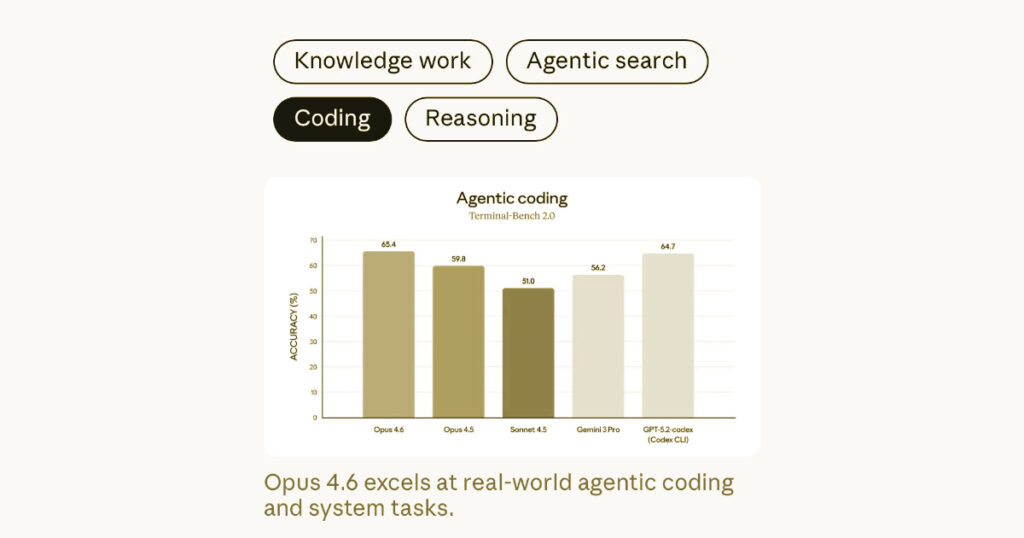
So, is it the best model yet? In terms of coding and following complex, multi step instructions, it is certainly a contender for the top spot.
The combination of adaptive thinking and the massive context window makes it a power user’s dream.
While there is still room for improvement in creative “vision” tasks, its ability to build functional, complex software from a single prompt is staggering.
If you are a developer, the agentic coding possibilities here are huge. The 128k output limit alone changes the game for building large scale applications.
Anthropic has clearly listened to the feedback from previous versions and focused on stability and depth. It is an exciting time to be in tech, and this latest update is a perfect example of why.