Ubisoft stock crashes by 33 percent following the cancellation of six games including Prince of Persia

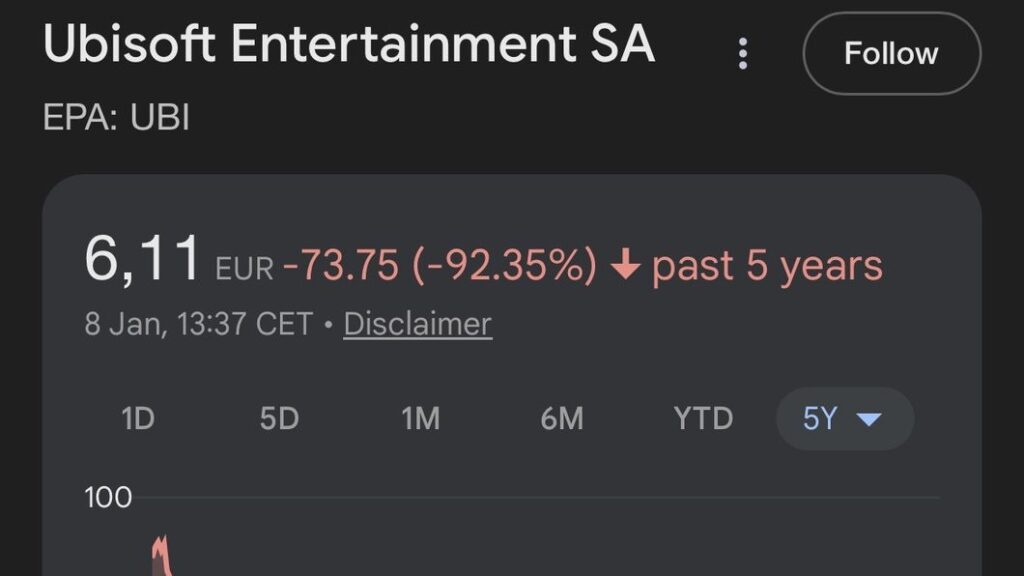
The Ubisoft stock crash gave the company its worst day in its 40 year history. The French gaming giant behind franchises like Assassin’s Creed and Far Cry announced on Wednesday evening that it is cancelling six games, closing two studios, and expects to lose around 1 billion euros this financial year. The news sent the stock into freefall, dropping 33 percent on Thursday morning in what became the biggest single day decline since the company went public in 1996. At its lowest point, Ubisoft’s market value fell to roughly 616 million euros, a stunning collapse from its peak of around 11 billion euros back in 2018.
Which games got cancelled?
The most high profile casualty is the Prince of Persia: The Sands of Time remake, which fans have been waiting for since it was first announced years ago. This remake has already been delayed multiple times and changed development studios at least once, so the cancellation, while disappointing, is not completely shocking. The other five cancelled games have not been named publicly, but Ubisoft confirmed they include several projects based on new intellectual properties rather than existing franchises.
Beyond the cancellations, seven more games are being delayed. While Ubisoft did not provide specific titles, reports suggest this includes an unannounced project that was expected before March 31, which many believe is a remake or remaster of Assassin’s Creed IV: Black Flag. That game is now pushed back to sometime before March 31, 2027, adding another year to the wait.
— Prince of Persia™ (@princeofpersia) January 21, 2026
Ubisoft is also shutting down studios
Ubisoft is closing two studios completely. Ubisoft Stockholm, which contributed to Avatar: Frontiers of Pandora, is being shut down. Ubisoft Halifax, which focused on mobile games, is also closing. Beyond those complete closures, the company is restructuring offices in Abu Dhabi, Helsinki, Malmö, and at RedLynx and Massive Entertainment. Layoffs are happening across all these locations, though Ubisoft has not specified exactly how many jobs are being cut.
The company is also implementing a return to office mandate that requires employees to work on site five days per week with only limited allowances for remote work. This comes at a time when many tech companies are moving in the opposite direction or settling on hybrid arrangements, so the timing and strictness of this policy has raised eyebrows.
What is the consequence of this move?
Ubisoft expects an operating loss of around 1 billion euros for the financial year ending in 2026. Part of that comes from a 650 million euro write down related to the cancelled and delayed projects. The company has also slashed its net bookings forecast for 2026 down to 1.5 billion euros, which is 330 million euros below what it previously told investors to expect. Even more concerning, Ubisoft has completely withdrawn its financial guidance for fiscal years 2026 and 2027, which signals the company has no clear visibility into when things will improve.
The company is targeting 500 million euros in cost savings and wants to reduce fixed costs from 1.75 billion euros in 2023 down to 1.25 billion euros by March 2028. To help stabilize its finances, Ubisoft says it may consider selling assets, though it has not specified what that might include. The company is also dealing with debt problems that came to light in November 2025 when an accounting change revealed a covenant breach, forcing Ubisoft to use part of a 1 billion euro investment from Tencent to repay outstanding loans early.
What is the new operating structure for the company?
As part of the restructuring, Ubisoft is reorganizing how it develops games. The company is creating what it calls Vantage Studios, which will oversee its biggest franchises including Assassin’s Creed, Far Cry, and Rainbow Six. Other creative houses will focus on specific genres. One will handle shooters like The Division and Ghost Recon. Another will manage live service games such as For Honor and Skull and Bones. There will be teams dedicated to narrative and fantasy titles including Rayman and Prince of Persia, and another for family and casual games like Just Dance and Uno.
The goal is to speed up decision making, sharpen creative focus, and place accountability closer to where value is created. Instead of decisions flowing through multiple layers of corporate bureaucracy, the teams working on each franchise will have more direct control and responsibility for outcomes. Whether this actually leads to better games or just creates more internal competition for resources remains to be seen.
Does AI have a role to play in this announcement?
One detail in the announcement that caught people off guard is that Ubisoft plans to accelerate investments in player facing generative AI despite all the cost cutting and game cancellations. The company specifically said its new operating model will be supported by accelerated investments into generative AI that players will directly interact with. This has not gone over well with the gaming community, many of whom view AI generated content as inferior to what human creators produce.
Ubisoft has been experimenting with AI tools internally for things like generating textures and assisting with coding tasks. But player facing AI is different. That could mean AI generated dialogue, procedurally created quests, or other content that players directly experience. The backlash from gamers has been strong, with many arguing that Ubisoft should be investing in people and creativity rather than algorithms, especially when the company is cutting jobs and shutting studios.
The next few months will be critical for Ubisoft. The company needs its remaining projects to hit their targets and perform well commercially. It needs to successfully implement the restructuring without completely destroying morale among the employees who are staying. And it needs to convince investors that this really is a turning point rather than just another round of cuts that will be followed by more bad news in six months. Based on how the market reacted to this announcement, there is a lot of skepticism that Ubisoft can pull it off.