
READ THIS before you buy the Vivo V70 Elite

There is a pattern with Vivo’s V series. They consistently spec-stack at a price point where most brands are quietly cutting corners. The V70 Elite continues that tradition, but this time Vivo has turned the dial up further than it ever has with the V line. The “Elite” tag is not just cosmetic. This phone marks the first time a V-series device has ever shipped with a Snapdragon 8-series processor, the phone runs Android 16 right out of the box, the cameras are built around Sony sensors tuned by Zeiss, and the battery chemistry is silicon-carbon rather than standard lithium-ion. All of that, and the base variant starts at Rs. 51,999.
The Vivo V70 Elite went on sale in India on February 26, 2026, and is available via Flipkart, Amazon, Vivo’s official online store, and offline retail partners including Croma, Reliance Digital, and Vijay Sales. Three variants are on offer: 8GB + 256GB at Rs. 51,999, 12GB + 256GB at Rs. 56,999, and 12GB + 512GB at Rs. 61,999.
Let’s take a deep dive into the Vivo V70 Elite so that you can ultimately decide if this is the smartphone for you or not.
Design and Build: Slim, Serious, and Genuinely Tough
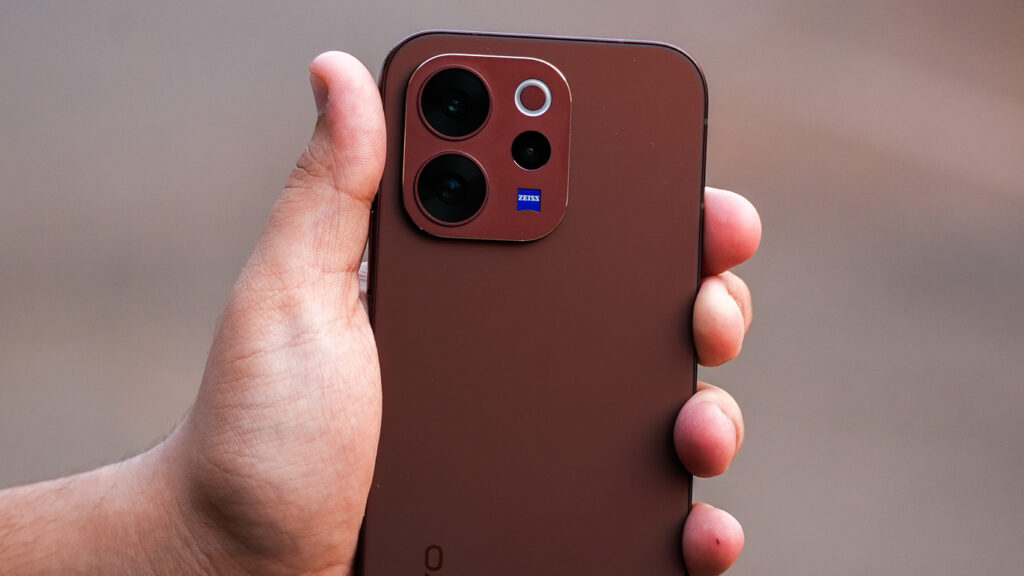
Vivo phones have always looked good. The V70 Elite continues that trend with an aerospace-grade aluminium alloy frame, a glass back, and flat edges that give it a clean, modern silhouette. The phone measures 157.52 x 74.33 x 7.4mm in the Authentic Black finish, making it genuinely slim for a phone packing a 6500mAh battery. The Passion Red and Sand Beige variants sit at 7.59mm thick. Weight lands at 187g for the Black version and 194g for the other two colourways.
Those dimensions matter because the feel-in-hand experience of a phone is directly connected to how often you reach for it. At 7.4mm, this is one of the slimmest phones you will find at this battery capacity anywhere near this price.
What is genuinely noteworthy is the IP68 and IP69 dual-certification. IP68 means the phone can be submerged in up to 1.5 metres of water for up to 120 minutes. IP69 adds resistance to high-pressure, high-temperature water jets. To put that in context: IP69 is a rating typically used for industrial equipment and military-grade hardware. On a mainstream mid-range smartphone priced at Rs. 51,999, it is rare. For someone who uses their phone outdoors regularly, works in dusty or wet environments, or simply has a history of phone accidents, this dual rating is a meaningful, real-world advantage.
The bezels measure 1.25mm on the sides, which Vivo claims is the narrowest in the segment at this price. The square-shaped camera module on the back follows current design trends without looking overdesigned.
One honest note: there is no 3.5mm headphone jack. Wired earphone users will need a USB-C adapter or a switch to wireless audio. That is a fair criticism.
Display: 1.5K AMOLED With Genuine Outdoor Credentials
The V70 Elite sports a 6.59-inch LTPS AMOLED flat panel running at a 2750 x 1260 pixel resolution. That works out to 459 PPI, which is sharper than the 1080p panels that are common at this price and noticeably so when reading text, viewing photos, or watching HDR video. This is a genuine 1.5K panel, not a marketing label applied to a Full HD screen.
The 120Hz refresh rate ensures that scrolling, animations, and gaming all feel smooth rather than choppy. At this price, 120Hz is expected, but it is still worth confirming it is here. HDR10+ support is present, meaning content from compatible streaming services like Netflix will render with better contrast and wider colour range compared to phones without HDR certification. The display also carries Widevine L1 certification, which is required to stream HD content from platforms like Netflix and Amazon Prime Video. A phone without L1 is locked to standard definition on those apps.
Peak brightness is rated at 5,000 nits. For outdoor use in Indian summer conditions, this level of brightness keeps on-screen content readable even in direct sunlight. The display also supports 4320Hz high-frequency PWM dimming, which reduces the flicker that can cause eye strain with low-brightness settings, a detail that matters for people who use their phones for extended periods at night.
Under the display sits a 3D Ultrasonic Fingerprint 2.0 sensor. Ultrasonic fingerprint sensors work using sound waves rather than light, which means they function reliably even with wet fingers. That is a practical advantage, particularly given the IP ratings on this phone.
The display also supports Always On Display, SGS Eye Protection certification, and an AOD feature Vivo calls Origin Island.
Performance: The Chipset That Changes the Conversation at This Price
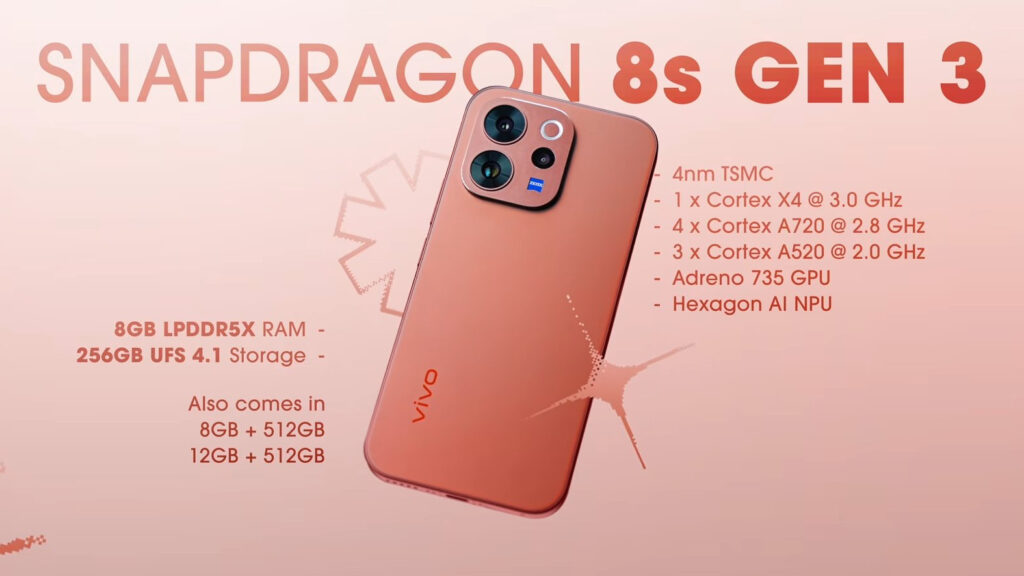
The biggest selling point of the Vivo V70 Elite is ofcourse, the Snapdragon 8s Gen 3 chipset. The 8s Gen 3 is built on a 4nm process and features an octa-core configuration: one prime Cortex-X4 core at 3.0GHz, four Cortex-A720 performance cores at 2.8GHz, and three Cortex-A520 efficiency cores at 2.0GHz. Graphics are handled by the Adreno 735 GPU. This chipset belongs to the Snapdragon 8-series family, the same family that powered flagship phones from Samsung and other OEMs in 2024.
The RAM is LPDDR5X, the fastest commercially available mobile RAM standard, and storage is UFS 4.1, which offers significantly faster read and write speeds compared to the UFS 3.1 standard found in older mid-range devices. This combination of chipset, RAM type, and storage standard means the V70 Elite punches well above its price tier in raw specification terms.
For gaming specifically, Vivo has confirmed 90fps BGMI support. The phone also features an X-axis linear motor for 4D vibration feedback, a hardware feature typically reserved for gaming-focused phones, and a 4200mm² vapour chamber cooling system to help manage heat during sustained workloads.
The phone ships with OriginOS 6 based on Android 16, making it one of the first devices commercially available with Android 16 out of the box. Vivo has committed to four years of major Android OS updates and six years of security patches. That software support commitment is above average for the Android mid-range segment, where two years of updates is still common.
Camera: Sony Sensors, Zeiss Optics, and a Periscope Telephoto
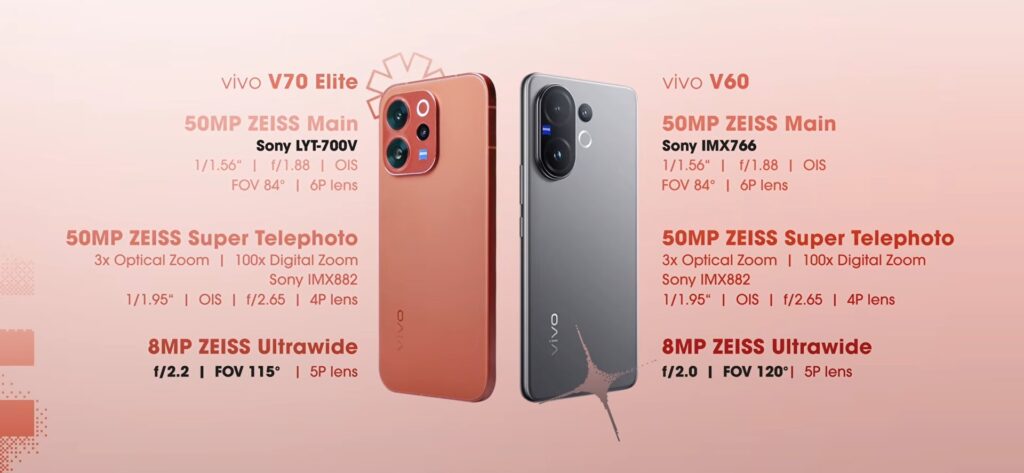
The camera system on the V70 Elite is where Vivo has made the most deliberate effort, and the spec sheet reflects it. The primary camera is a 50MP shooter using a Sony IMX766 sensor with a 1/1.56-inch size, f/1.88 aperture, PDAF, and OIS. The IMX766 is a well-established Sony sensor with a strong reputation across multiple devices in this price bracket and above. The 1/1.56-inch size is generous, allowing more light to hit the sensor, which translates to better low-light performance.
OIS adds hardware-level stabilisation that compensates for hand movement, reducing blur in photos and helping stabilise video footage.
The second camera is a 50MP ZEISS Night Telephoto with a 1/1.95-inch Sony IMX882 sensor, f/2.65 aperture, 3x optical zoom, a periscope design, and OIS. The word “periscope” matters here. A periscope telephoto uses a prism to redirect light horizontally through the phone body, allowing for longer focal lengths without requiring the camera module to protrude significantly. The result is true 3x optical zoom without the image quality loss that comes with digital zoom, and the OIS on this lens means telephoto shots are stabilised against hand shake. Zeiss has co-engineered this lens specifically for portrait and night photography at distance, and the Night Telephoto branding signals that this is the use case Vivo has optimised for.
The third camera is an 8MP ultrawide with a 115-degree field of view and f/2.2 aperture. This is the weakest link in the system. 8MP in 2026 is behind the curve, particularly when the other two sensors are 50MP. Wide-angle shots will have noticeably less detail compared to the main camera. This is a genuine compromise and buyers who rely heavily on ultrawide photography should factor this in.
On the front, the 50MP selfie camera uses an f/2.0 aperture, a 92-degree field-of-view wide-angle lens, and crucially, autofocus. Autofocus on a front camera is not standard at this price. It means the camera can actively lock focus on a subject rather than relying on fixed focus, which results in sharper selfies and more reliable video call quality when you move around.
Video recording reaches 4K at 60fps on the main camera, which corrects an earlier preliminary spec that suggested 4K at 30fps only. The combination of OIS and gyro-EIS provides dual-layer stabilisation for video, which is a meaningful advantage for anyone shooting handheld footage.
Vivo has also included an Aura Light on the telephoto camera, which is a ring LED designed to provide softer, more even lighting for portrait and close-up shots. AI photography features include AI Audio Noise Eraser, AI Floral Blessing, AI Magic Weather, AI Magic Landscape, AI Retouch, AI Erase, AI Image Expander, and an India-exclusive AI Holi Portrait. Google’s Gemini Live and Circle to Search are also built in, as is Live Call Translation and AI Transcript Assist.
Battery: One of the Best Hardware Stories at This Price
The 6500mAh silicon-carbon battery is one of the headline specifications of the V70 Elite, and the chemistry behind it matters. Silicon-carbon (Si/C) batteries use a silicon-carbon composite anode instead of the pure graphite anode in standard lithium-ion batteries. Silicon can absorb more lithium ions than graphite, which means higher energy density. The practical result is a larger-capacity battery that does not require a proportionally larger or heavier phone body. At 7.4mm thin and 187g, the V70 Elite demonstrates this well.
90W wired fast charging with Power Delivery support brings the 6500mAh cell from empty to full in a time frame that makes it genuinely practical for daily use. Vivo rates the battery for 40 hours of video playback under their test conditions. Actual daily use will vary based on network, screen brightness, and app behaviour, but a large silicon-carbon cell at 6500mAh is about as solid a battery foundation as you will find at this price.
There is no wireless charging on this phone. If wireless charging is part of your daily routine, the V70 Elite does not offer it.
Connectivity: Comprehensive, With One Notable Gap
Wi-Fi 6 (802.11 a/b/g/n/ac/6), dual-band across 2.4GHz and 5GHz, Bluetooth 5.4, NFC, an IR blaster, GPS with L1 and L5 band support, GLONASS, Galileo, QZSS, BDS, and NavIC are all present. NavIC is India’s regional satellite navigation system, and L1 + L5 dual-band GPS provides more precise positioning than single-band GPS, which matters for navigation accuracy in urban environments with tall buildings.
NFC enables tap-to-pay through UPI and contactless card payments. The IR blaster allows the phone to function as a remote control for TVs, air conditioners, and other home appliances.
The USB port is Type-C 2.0. This handles charging at the full 90W speed and supports OTG, but USB 2.0 is limited in data transfer speeds compared to USB 3.1 or 3.2. For users who regularly move large files between their phone and a computer via cable, this will feel like a bottleneck. For everyone else, it is a non-issue in daily use.
5G is supported across both SA and NSA modes, and dual 4G VoLTE is available. Stereo speakers are included.
Software: Android 16 and a Longer Support Cycle
Running OriginOS 6 on top of Android 16, the V70 Elite is among the earliest mainstream devices to ship with the latest version of Android. OriginOS 6 brings AI features both from Vivo and from Google, including Gemini Live integration, Google’s Circle to Search, and Live Call Translation. For Indian users specifically, Vivo has included a limited-time AI Holi Portrait mode.
The four-year Android update and six-year security patch commitment is among the better software support promises available in this segment, and it is an important factor in the long-term value equation of any smartphone purchase.
Who Is the Vivo V70 Elite Phone Actually For?
The Vivo V70 Elite is built for someone who wants near-flagship hardware without paying a flagship price. The Snapdragon 8s Gen 3, the Sony-sensor camera system with periscope telephoto, the silicon-carbon 6500mAh battery, dual IP68/IP69 ratings, and a 1.5K 120Hz AMOLED panel at Rs. 51,999 represent a genuinely strong package by any objective measure.
It is particularly well-suited to power users who need long battery life, to outdoor users who need a water-resistant phone they do not have to baby, and to anyone who values telephoto camera performance in a mid-range device.
It is not the right pick for someone who needs wireless charging, shoots a lot of ultrawide content and needs high resolution from that lens, or prefers a more compact phone. These are real trade-offs, not minor footnotes.
TattwaTech Score – 8.7/10
The Vivo V70 Elite has genuine compromises: the 8MP ultrawide camera is underwhelming, wireless charging is absent, and USB 2.0 limits wired data transfer speeds. These are fair criticisms, and no buyer should overlook them.
But the total package is hard to dismiss. A Snapdragon 8s Gen 3 chipset with LPDDR5X RAM and UFS 4.1 storage, a Sony IMX766 primary sensor with OIS, a Sony IMX882 periscope telephoto with 3x optical zoom and OIS, 4K/60fps video, a 6500mAh silicon-carbon battery, dual IP68/IP69 water resistance, a 1.5K 120Hz AMOLED panel at 459 PPI, a 3D Ultrasonic Fingerprint 2.0 sensor, Android 16 with four years of updates, and all of it in a 7.4mm body at Rs. 51,999 is a combination that most competing phones at this price simply cannot match on paper.
Vivo has built something that gives ordinary buyers access to hardware that was, until recently, the exclusive territory of phones priced significantly higher.
Buy it for the performance, the battery, and the cameras. Know what you are giving up. Then decide.






[…] MediaTek Helio G200 Ultimate is the core of the Camon 50 Pro. Understanding what it does well and where its limits are will help […]