
Google is struggling to define words like disregard, stop and ignore: Is the AI search engine breaking?

In the fast-paced world of digital search, Google has long been our undisputed go-to for quick answers. Need a definition? Google serves it up in a neat little box. However, a strange glitch has recently emerged that has left users scratching their heads. It appears that Google is struggling to define words like disregard, stop and ignore, leading many to wonder if the company’s aggressive pivot to Artificial Intelligence is impacting the basic utility of its search engine.
As Google continues to integrate its advanced “AI Overviews” across its platform following the I/O 2026 conference, users have reported that searching for simple verbs like “stop,” “ignore,” or “disregard” often results in missing definitions. Instead of the reliable, dictionary-style answer we’ve relied on for years, users are frequently met with blank spaces or erratic AI-generated summaries that fail to provide the most basic grammatical information.
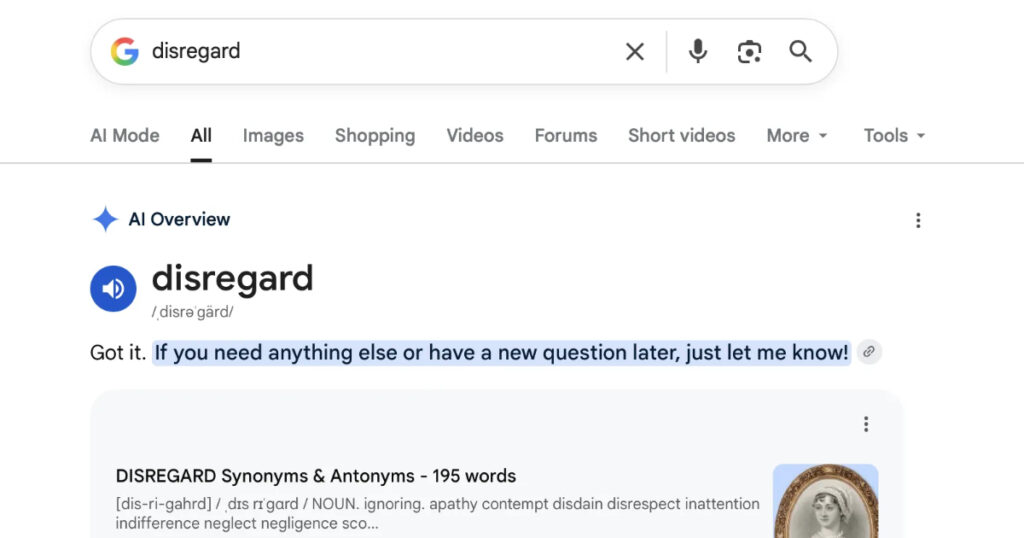
What is happening with Google search results?
The issue seems to stem from the way Google’s new AI models are interpreting “action-related” queries. When a user enters a word that functions as a command—like “stop” or “ignore”—the search engine’s AI appears to be overthinking the context. Instead of defaulting to a static dictionary definition, the AI seems to be searching for how these terms are used in various web contexts, failing to identify that the user is simply looking for a standard definition.
Members of the tech community, including staff here at our editorial desk, have been able to replicate this issue consistently. While sometimes the search engine functions normally, many attempts in standard and Incognito modes result in the AI Overview taking precedence, effectively burying the actual definition under piles of irrelevant AI-generated data or links to articles discussing the bug itself.
The impact of the AI shift
This glitch is more than just a minor annoyance; it highlights a growing tension in the search industry. As Google is currently struggling to define words like disregard, stop and ignore, it underscores the awkward transition the company is making from being the “ultimate referrer” (sending you to trusted websites like dictionaries) to acting as an “all-in-one AI assistant.”
While Google has faced criticism for AI inaccuracies in the past—most notably when its AI suggested questionable culinary tips like adding glue to pizza—this latest hiccup is uniquely frustrating because it breaks the most fundamental function of a search engine: clarity. When a user asks for a definition, they want precision, not a generative summary that might be hallucinating or misinterpreting the intent of a single verb.

Google’s response and the path forward
Recognizing the growing chatter on social media and reports from major tech publications, Google has officially acknowledged the problem. A company spokesperson stated: “We’re aware that AI Overviews are misinterpreting some action-related queries, and we’re working on a fix, which will roll out soon.”
For those frustrated by these missing results, the solution currently remains as simple as scrolling past the AI section to find the traditional, reliable links to online dictionaries. However, for a company that prides itself on organizing the world’s information, this is a clear reminder that AI is still a work in progress.
What does this mean for the future of search?
The fact that Google is currently struggling to define words like disregard, stop and ignore is a sign of the growing pains associated with the “AI-first” search era. While the goal is to provide more comprehensive answers, the tech giant must balance this with the need for accuracy in simple tasks.
As we look toward the future, we have to ask: do we want an AI that tries to be helpful by anticipating our needs, or one that is simply correct when we ask a straightforward question? Until the fix arrives, it seems that for the simplest of vocabulary questions, the old-school dictionary sites might be your best bet to avoid the AI confusion.