
Return from Summer Leave Creates New Openings for Phishing and Fraud, Proofpoint Says

Summer changes how people work, and most of the security advice that circulates around it stops at the departure gate, focused on hotel Wi-Fi, travel scams and booking fraud. The exposure does not end when employees come home though, it simply moves, and it concentrates in the first days back, when people return to weeks of unread messages, restored access and decisions taken without them, and work through all of it at a pace that leaves little room to question anything that looks routine.
That matters in a market where the inbox is already the dominant point of failure. The UAE Cyber Security Council has warned that more than 75% of cyberattacks now begin with a phishing email or fraudulent message, which places the burden of detection on individual judgment at precisely the moment that judgment is most stretched.
- Access friction creates cover for fake support
Returning employees spend their first days resetting passwords, re-enrolling MFA, restoring licences and working through expired credentials, and when broken access is the norm rather than the exception, an error prompt or an unexpected call from IT stops looking out of place. The instinct in that moment is to resolve the problem rather than interrogate it, and attackers build campaigns around exactly that instinct. Proofpoint research found ClickFix malware campaigns increased nearly 400% year-over-year, a technique that lures users into running malicious code by displaying fake error messages or CAPTCHA screens.
- Inbox backlogs reward speed over scrutiny
Employees working through several hundred messages process email as a queue rather than as a series of individual decisions, and the distinction matters because attackers do not need to defeat scrutiny when they can arrive in the week there is none. Proofpoint research shows that malicious URLs are now the preferred delivery mechanism, used four times more than attachments in email threats, and a link only ever required a single click to work.
- Out-of-office replies hand over the org chart
A standard out-of-office reply gives a sender the return date, the name of whoever is covering and usually their direct line, and it keeps handing that out to anyone who writes in, for weeks. Proofpoint’s 2026 AI-Era Ransomware Report points to attackers using AI to write more targeted impersonation messages and to carry out faster reconnaissance of organizational structures and message patterns, and an auto-reply spares them most of that work.
- Temporary approval chains create openings
Summer leave moves payment approvals and business decisions to colleagues covering temporarily, and those substitutes hold the authority without the context that normally accompanies it, having no baseline for what a routine request from a particular supplier looks like or how a given executive usually phrases one. That missing baseline is where these attacks succeed, and it shows in how organizations describe them afterwards. Proofpoint’s 2026 AI-Era Ransomware Report found that among UAE organizations hit by ransomware, 36% said employees did not suspect the attack because it appeared authentic.
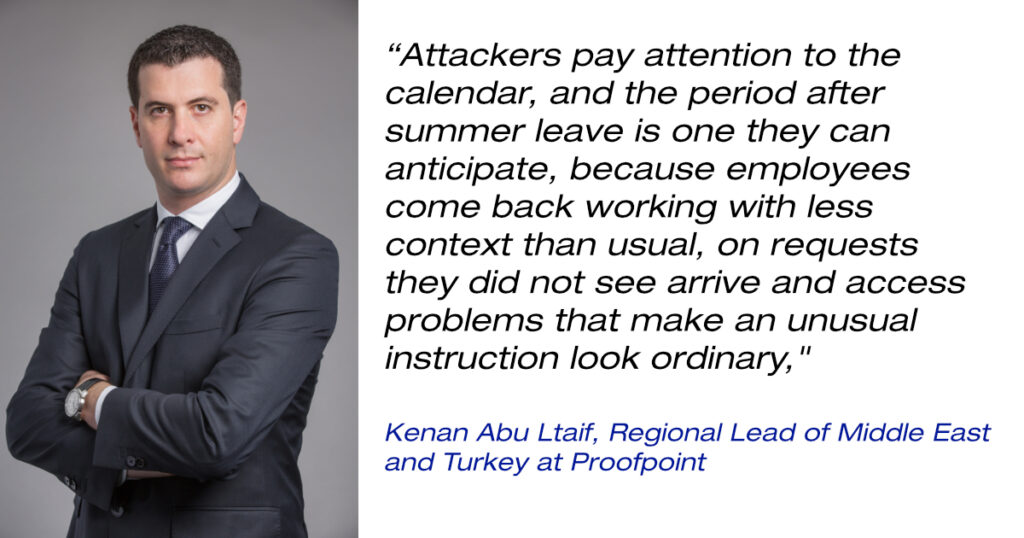
“Attackers pay attention to the calendar, and the period after summer leave is one they can anticipate, because employees come back working with less context than usual, on requests they did not see arrive and access problems that make an unusual instruction look ordinary,” said Kenan Abu Ltaif, Regional Lead of Middle East and Turkey at Proofpoint.
“People remain at the center of cyber risk, and what makes this period different is that the pressure on them is entirely predictable, which means it is something organizations can prepare for rather than react to.”
The return is worth treating as a review period rather than a straightforward resumption of normal operations. Requests to resolve a technical issue, particularly those that ask a user to run a command or re-enter credentials, should be verified through internal IT rather than through the message that raised them, and payment instructions received during the leave period, along with any approvals made by temporary delegates, are worth confirming with a known contact before they are actioned.
It is also a practical moment to review what out-of-office templates disclosed over the summer and to tighten them before the next leave cycle.