HP Googlebook 14 brings a more connected way to work

The HP Googlebook 14 is built around a simple idea: the modern laptop should not feel like a separate island from the phone people already use every day.
Announced by HP in September 2026, the premium 14-inch laptop brings together Google’s new Googlebook experience, Gemini intelligence, Snapdragon X Elite performance and deeper connectivity with supported Android phones. Instead of treating the laptop and smartphone as two independent devices, HP is positioning the Googlebook 14 as a central workspace where files, apps, tasks and communication can move more naturally between screens.
The significance of the HP Googlebook 14 is therefore less about adding another premium laptop to the market and more about changing how a laptop fits into a device ecosystem.
For freelancers, creators, independent professionals and small business owners, that distinction matters. A typical workday rarely stays inside one device. A message may begin on a phone, a document may be edited on a laptop, a photograph may be stored on the phone, and a quick task may require an app that was originally designed for a mobile screen.
The Googlebook 14 is designed around that reality.
A laptop designed around the phone
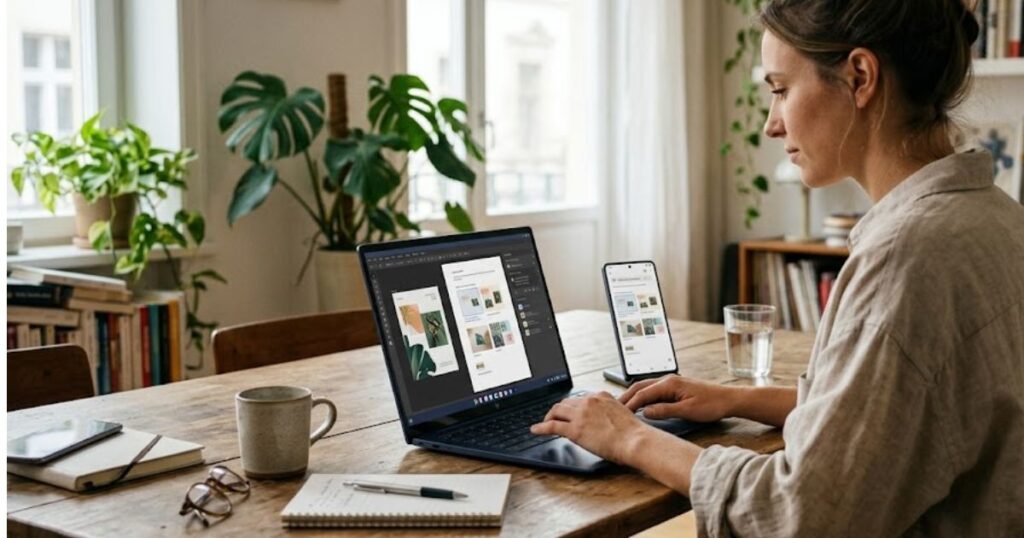
The most interesting part of the Googlebook experience is its connection with supported Android devices.
Through features including Quick Access and Cast my Apps, the laptop can bring parts of the phone experience directly into the computer workflow. Users can access phone files through the laptop’s file browser and open supported phone apps from the laptop without separately installing those apps on the computer.
This addresses a small but persistent problem in everyday computing: interruption.
Without deeper integration, moving from phone to laptop often means sending a file to yourself, searching through cloud storage, opening a web version of an app or picking up the phone again for a task that takes only a few seconds.
The Android phone integration in Googlebook is designed to reduce those small interruptions.
The result is not necessarily a dramatic change to how someone uses a computer. Instead, it is a collection of smaller conveniences that can make a working day feel less fragmented.
Gemini becomes part of the workflow
AI is another major part of the Googlebook proposition.
The Gemini laptop experience is designed to make AI assistance part of everyday computer use rather than something that requires opening a separate chatbot or browser tab.
HP highlights features such as Proactive Suggestions, Magic Pointer and Rambler.
Magic Pointer is designed around using the pointer to activate Gemini and interact with content on the screen. Rambler focuses on voice input, helping turn less structured spoken thoughts into cleaner text. HP describes these features as ways to surface relevant information, provide contextual assistance and turn rough thoughts into more organised content.
That approach is worth watching because useful AI on a laptop is increasingly less about asking a chatbot a single question and more about reducing the distance between an idea and the action that follows it.
For a freelancer, that might mean turning a rough voice note into structured text. For a small business owner, it could mean getting contextual assistance while working through information. For a creator, it could mean moving more quickly from an initial idea to a usable piece of content.
The important point is that these capabilities are being built into the computing experience rather than presented as a completely separate destination.
Snapdragon X Elite targets mobile performance
Under the hood, the HP Googlebook 14 uses the Snapdragon X Elite platform.
HP specifies the Snapdragon X Elite X1E-80-100 processor in current configurations, with up to 12 CPU cores and a Qualcomm Hexagon NPU rated at 45 TOPS. Configurations can include up to 32GB of LPDDR5x memory, depending on the model.
For buyers searching for a Snapdragon X Elite laptop, the attraction is not simply the processor name. The larger story is the combination of performance, efficiency and portability.
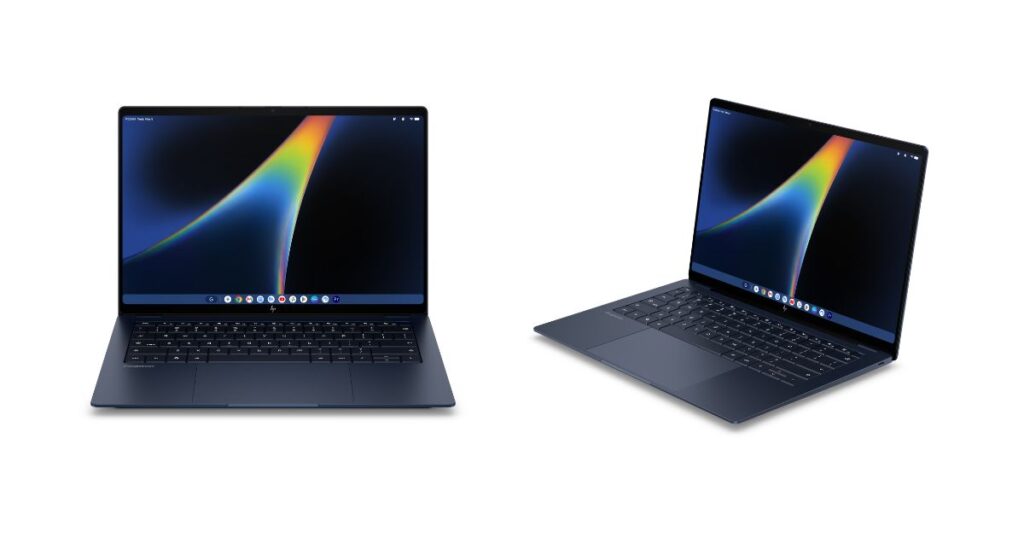
The Googlebook 14 measures just 10.91mm thick, according to HP, and is rated for up to 19 hours of battery life. It also uses a vapor chamber cooling system and comes with a compact USB-C GaN charger.
Battery claims should always be understood as manufacturer-rated figures rather than a guarantee of identical real-world usage. Actual endurance will depend on workload, display settings, applications and other factors.
Still, the direction is clear. HP is targeting people who want a full laptop experience without carrying a machine that feels like desktop hardware squeezed into a portable chassis.
The display is built for more than spreadsheets
The display is another area where HP is pushing the Googlebook 14 beyond the traditional idea of a basic productivity laptop.
The laptop features a 14-inch 3K OLED touchscreen with a resolution of 2880 × 1800 and up to a 120Hz variable refresh rate. Current HP specifications also list 500 nits brightness and 100% DCI-P3 coverage for the OLED configuration.
That combination makes the machine relevant to more than office work.
A creator working with photographs, video, design assets or visual presentations benefits from a high-resolution OLED panel, while the touchscreen adds another way to interact with content.
The laptop also includes a 5MP IR camera with facial recognition, quad speakers and HP Audio Boost 2.0. HP says the device can support up to two UHD external monitors, giving users the option to build a larger desktop setup when they are back at a fixed workspace.
There is also a small but distinctive hardware detail: the Glowbar. It provides an at-a-glance indication of battery and charging status, including when the laptop is closed.
These details are easy to overlook in a specification sheet, but they contribute to the broader idea behind the machine. The Googlebook 14 is designed to move between focused work, meetings, creative tasks and entertainment without requiring a completely different setup for each.
A premium design with a sustainability angle
The Googlebook 14 also reflects the wider shift in premium computing toward recycled and more carefully sourced materials.
HP says the laptop uses recycled metal, post-consumer recycled material in keyboard components, ocean-bound plastic and sustainably sourced packaging. It carries EPEAT Gold with Climate+ certification.
These claims are more useful when viewed as part of the product’s overall design strategy rather than as a reason to buy the laptop on their own.
The premium laptop market has increasingly moved beyond raw specifications. Build quality, repairability, energy use, materials and the environmental impact of manufacturing are becoming part of the conversation around what makes a modern computer premium.
HP is placing those considerations alongside the Googlebook 14’s performance and design rather than treating them as a separate message.
Who is the Googlebook 14 for?
The Googlebook laptop concept becomes easier to understand when viewed through the people HP is targeting.
HP specifically positions the Googlebook 14 for independent professionals, creators, freelancers, small business owners and premium Android users.
These users often have a hybrid workflow.
They may work from home in the morning, move to a cafe, join a video meeting from another location and continue working from their phone while travelling. Their work may involve documents, communication, visual content, browser-based tools, AI assistance and mobile applications within the same day.
For this group, a laptop’s value is not only measured by processor speed or screen resolution.
It is also measured by how much friction exists between one task and the next.
That is where the Googlebook 14 has an interesting proposition. Its hardware is premium, but its bigger selling point is the relationship between the hardware, Google’s AI experience and the Android ecosystem.
The software experience may matter more than the hardware
Premium laptops have reached a point where specifications alone do not explain the complete user experience.
A faster processor is useful. A brighter OLED screen is useful. More battery life is useful.
But if a user still has to repeatedly move files between devices, search for mobile apps, copy information from a phone to a laptop or interrupt a workflow to perform a simple phone task, the underlying experience can still feel fragmented.
The HP Googlebook 14 approaches that problem from the software side as much as the hardware side.
Its Android integration, Gemini features and Googlebook environment are intended to make the laptop feel more connected to the rest of the user’s digital life.
That could prove particularly relevant as AI assistants become more deeply embedded in operating systems. The next stage of laptop design is not simply about making computers faster. It is about making computers more aware of what users are trying to accomplish and reducing unnecessary steps along the way.
Pricing and availability
HP announced the Googlebook 14 with a starting price of $1,199.99, with availability through HP.com and Best Buy expected from October 2026.
The launch package also includes a 12-month Google AI Pro membership at no additional cost. According to HP, this includes expanded access to Gemini, Flow and Gemini Notebook, along with 5TB of cloud storage.
HP also announced a bundle of selected apps and services with a stated value of up to $350, including Adobe Photoshop, CapCut, YouTube Premium and NVIDIA GeForce NOW.
Because laptop configurations, pricing and availability can change by market, buyers should check the local HP product page before making a purchase. HP’s current US product listings show multiple configurations, including different memory and storage options.