
AI data center cooling just got a safety net from aerospace tech

AI data center cooling has become one of the quiet but serious problems of the AI boom. The chips that power modern AI run extremely hot, and even a short break in cooling can slow them down or damage them. Honeywell Aerospace and Equinix have now tested a device called the Thermal Response Module (TRM) that is built to act like a safety net for these cooling systems. Here is what it is, how it works, and why it matters.
Quick answer: The Thermal Response Module is a drop-in unit that sits between a data center’s coolant distribution unit and its servers. It uses phase-change materials to soak up and release heat quickly, which keeps coolant temperatures steady during power problems or sudden jumps in computing demand. It was tested at the Equinix Co-Innovation Facility in Ashburn, Virginia.
Why AI data center cooling is harder than it looks
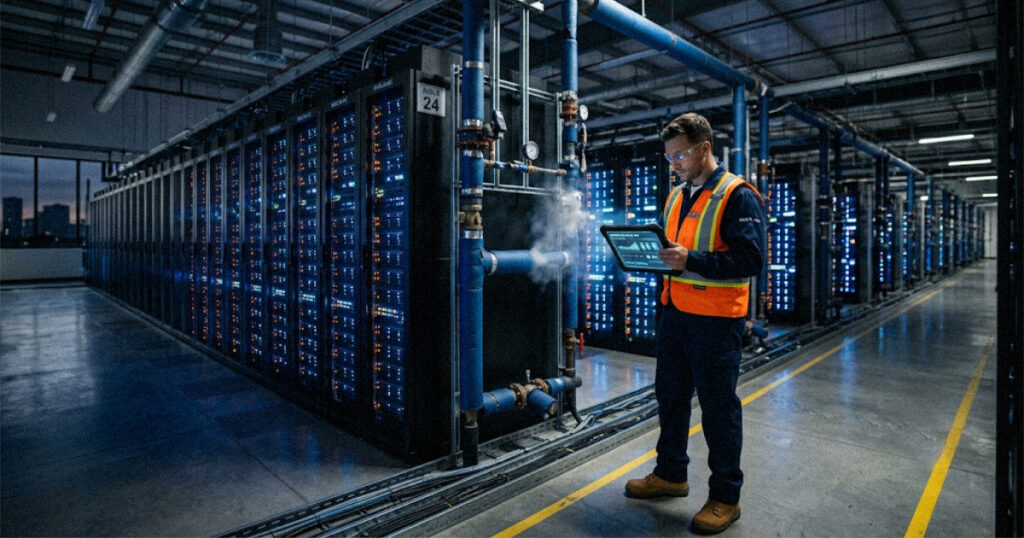
Think about a normal laptop. When you run a heavy video edit, the fan gets loud, but nothing terrible happens. Now imagine thousands of powerful chips packed into rows of racks, all working at full speed for hours. That is an AI data center.
The chips doing most of this work are graphics processing units, or GPUs. They are expensive and they produce a lot of heat in a small space. When they get too hot, they protect themselves by slowing down. This is called throttling. Slower chips mean slower AI training, slower answers for customers, and wasted money.
This is why GPU cooling is now a top concern for anyone running AI at scale. Cooling is no longer a background job. It decides how much work the hardware can actually do.
Why liquid cooling for data centers is becoming the new normal
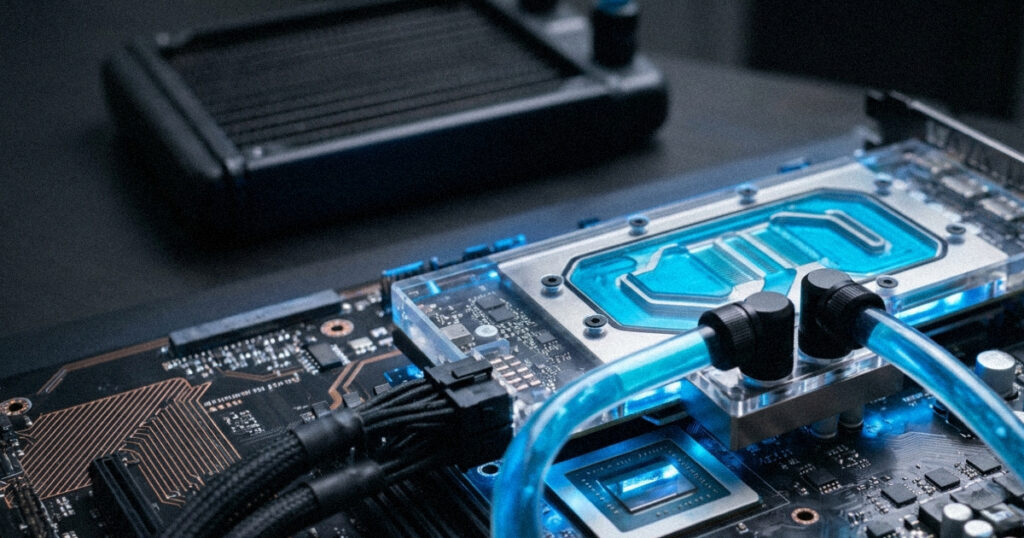
Air cannot carry heat away fast enough from very dense AI hardware. So many operators are switching to liquid cooling for data centers. In the most common setup, called direct-to-chip cooling, a liquid flows through small plates that sit right on top of the processors and carries the heat away.
According to research firm Omdia, some form of liquid cooling is used in fewer than half of data centers today. The same research expects this market to grow by about 20% each year over the next five years. So this is still an early and fast-moving area, and many operators are learning as they go.
A simple picture helps. A liquid cooling system works a bit like the radiator in a car. The coolant moves through the hot parts, then through a unit that removes the heat, then back again. A key part is the coolant distribution unit, or CDU, which controls how the coolant flows between the building’s cooling system and the servers.
What goes wrong when cooling stutters
Liquid cooling is powerful, but it can be sensitive. A small power dip, a sudden surge in AI workload, or a hiccup somewhere else in the cooling system can change the coolant temperature quickly. The wider system, such as chillers and pumps, often needs time to catch up.
In that gap, the chips keep making heat. If the coolant warms up even for a short time, GPUs can throttle or, in a worse case, the hardware can be put at risk.
A realistic example
Let us use a made-up but realistic case. Imagine a mid-sized company called Northline Cloud that rents AI computing power to start-ups. One afternoon, a short power disturbance makes a chiller restart. It takes a couple of minutes to get back to full strength.
During those minutes, a customer is halfway through training an AI model on hundreds of GPUs. The coolant warms up, the GPUs begin to throttle, and the training job slows down badly. The customer notices, the service level agreement (the promise of how reliably the service will run) is now at risk, and the support team is busy answering angry messages.
Nothing was broken. The cooling just paused for a short moment, and that was enough to cause real trouble. This is the exact kind of problem the Thermal Response Module is designed to prevent.

What is the thermal response module?
The thermal response module is a ready-made unit from Honeywell Aerospace. It is built to be added to an existing liquid cooling loop, between the CDU and the servers. According to the announcement, it does not need a redesign of the system and works with any CDU vendor or design.
It is best understood as a thermal buffer. A buffer is something that absorbs a shock so that the rest of the system does not feel it. Think of a shock absorber on a bike. The road is bumpy, but you stay steady.
The module combines three things:
- Engineered phase-change materials that store and release heat
- Heat-exchanger designs that support quick or long-lasting cooling
- Built-in sensors that show how much cooling capacity is left, known as state-of-charge sensing
Together, these help keep temperatures steady and make chillers, CDUs and other upstream equipment work more consistently.
How phase-change materials keep GPUs cool
You already know phase-change materials from daily life. Ice is a simple example. When ice melts, it takes in a lot of heat without getting warmer itself. That is why a cold drink with ice stays cold for a long time.
Phase-change materials work on the same idea, but they are engineered for specific temperatures. When the coolant gets too warm, the material melts and absorbs the extra heat. Later, when things settle down, it releases that heat and resets, ready for the next spike.
This gives an immediate response. While the bigger cooling system is still reacting, the module is already working. According to Honeywell Aerospace, it delivers 7.6 times more cooling power than chilled water, steadies the cooling loop within seconds, and can be built to give several minutes of buffering.
Why a technology from aerospace works in data centers
It may sound strange that a part of this solution comes from aerospace and defense. But the company points out that heat loads in aircraft and defense systems closely mirror those in data centers. Both places pack powerful electronics into tight spaces. Both cannot afford to overheat. Both need to keep running without a break.
Rich DeGraff, president and CEO of Control Systems for Honeywell Aerospace, said the company took phase-change technology built for mission-critical aerospace systems and applied it to a similar challenge in AI infrastructure.
This is a good reminder that old, proven ideas can find new life in new industries.
What Equinix found in testing
Equinix, a global digital infrastructure company, tested and installed the module at its Co-Innovation Facility in Ashburn, Virginia. Pawel Wlodarczak, design innovation director for Global Design at Equinix, said the testing showed the technology can handle rapid GPU cooling load changes. He also said it needs a smaller footprint than buffer tanks.
That last point matters. Buffer tanks, which are large tanks of cooled liquid, are a common way to smooth out temperature changes. But they take up valuable floor space. A smaller unit leaves more room for servers that earn money.
What this could mean for data center operators
According to the announcement, operators could gain several practical benefits:
- Fewer temperature spikes, which means fewer throttled GPUs
- Lower service level agreement risk, since short cooling hiccups matter less
- A larger safety margin, which can allow higher coolant loop temperatures
- More power for computing, because less power needs to go to cooling
- Easier setup, since the module drops into an existing loop
- Flexible size, from small edge sites to large AI clusters
Going back to Northline Cloud, the same chiller restart would now be much less dramatic. The module would absorb the extra heat for those few minutes. The GPUs would keep running at full speed, and the customer would likely never notice.
Frequently asked questions
What is the Thermal Response Module?
It is a drop-in cooling buffer from Honeywell Aerospace that uses phase-change materials to keep coolant temperatures steady in liquid-cooled AI data centers.
Does the module need a new cooling system?
No. According to the announcement, it fits into an existing cooling loop between the CDU and the servers and works with any CDU vendor or design.
How fast does it work?
It is said to steady the cooling loop within seconds and can be built to provide several minutes of thermal buffering.
Why is cooling so important for AI chips?
AI chips produce a lot of heat. If they get too hot, they slow down to protect themselves, which hurts performance and can risk the hardware.
Who tested it?
Equinix tested and installed it at its Co-Innovation Facility in Ashburn, Virginia.