
Crazy Taxi: World Tour is the nostalgia hit gaming needs right now

There is something that happens when you hear those opening guitar chords of “All I Want” by The Offspring. If you were a gamer in the late 90s or early 2000s, your brain does not process it as just a song. It processes it as a memory. The smell of an arcade. The grip of a plastic steering wheel. The countdown timer ticking in the corner of the screen. Your passenger yelling at you to hurry up while you launched your yellow cab off a ramp and somehow landed it perfectly on a crowded street.
Crazy Taxi: World Tour was announced at the Xbox Games Showcase this week, and the moment that trailer dropped with The Offspring blasting over footage of Axel tearing through San Francisco, the internet collectively lost its mind. In a good way.
And honestly? Good. Gaming needs this right now.
Crazy Taxi World Tour and why nostalgia is not a dirty word
People sometimes say nostalgia is a lazy reason to be excited about a game. I disagree. Nostalgia is not just about wanting to feel young again. It is about recognising that something was genuinely special and wanting more of it.
The original Crazy Taxi, released on the Sega Dreamcast in 1999 and hitting arcades around the world, was one of those games that was almost impossible to explain to someone who had not played it. You are a cab driver. You pick up passengers.
You get them to their destination as fast as possible, and the more insane your route, the better your tip. That was basically it. And yet you could lose hours to it. The chaos of the driving, the personality of the characters, the way the game rewarded you for thinking creatively about the road in front of you. It was simple, joyful, and completely its own thing.
Then it went quiet. For over two decades, Crazy Taxi essentially disappeared. There was a forgettable mobile spinoff in 2017, and then nothing. While other Sega franchises got revisited and revived, Crazy Taxi sat on the shelf gathering dust.
So when Sega finally confirmed the revival with original creator Kenji Kanno leading the project, my reaction was not “finally, the franchise is saved.” It was something more personal than that. It was the feeling of seeing an old friend walk through the door.

The balancing act: can World Tour be both crazy and big?
Here is the part that requires more than just excitement. Because the Crazy Taxi: World Tour that Sega is building is not a simple remaster of the original. It is a significantly more ambitious game, and ambition in gaming is always a double-edged thing.
The new game has five global cities, each with a day and night version. It has a full story campaign where protagonist Axel is hunting down the masked thieves who stole his beloved taxi. It has online multiplayer where you compete against other players across platforms. It has side missions, vehicle customisation, time attack challenges, and the classic arcade mode for purists. Oh, and apparently you can drive into the ocean and pick up a passenger who wants to go fishing. Which is exactly the kind of absurdity that tells you Kenji Kanno still has the spirit of the original game in his DNA.
All of that sounds great on paper. But it is worth thinking carefully about what made the original so good in the first place.
The magic of the first game was that it never got in its own way. You did not have to navigate menus or manage a story. You just drove. Every session was immediate. You picked it up, the music hit, and you were already in it. The game had the energy of a sprint, not a marathon.
The risk with everything Sega is adding to World Tour is that the game starts to feel like a marathon dressed up as a sprint. Story modes in games like this can be wonderful, but they can also slow things down in a way that the original never would have tolerated. Open worlds are great until they feel empty between the exciting bits. Multiplayer is fantastic when it works and miserable when it does not.
Sega’s original pitch for this game, back in 2023, described it as an “open-world massively multiplayer AAA game.” What we are actually getting in 2027 sounds more grounded than that: five cities, a structured campaign, and multiplayer modes. That is probably a good thing. It suggests Sega course-corrected from an overblown original vision into something more focused.
The question I am sitting with is whether Kanno and his team have found the balance between giving the game enough substance to feel worthy of a 2027 release, without burying the spontaneous, chaotic, gloriously stupid joy that made people fall in love with it in the first place. If they manage that, World Tour could genuinely be one of the best revivals in gaming history. If they get the balance wrong and it ends up feeling like a GTA clone with a Crazy Taxi skin, it will be a disappointment that the franchise does not deserve.
I want to believe they can do it. The involvement of Kenji Kanno gives me real confidence. This is not a studio that bought the IP and handed it to a team who never played the original. The man who created it is in the room, and from everything shown so far, he clearly still cares deeply about what made it special.
The AI controversy: transparency is not optional
There is a conversation happening alongside all the excitement, and it is one worth having properly.
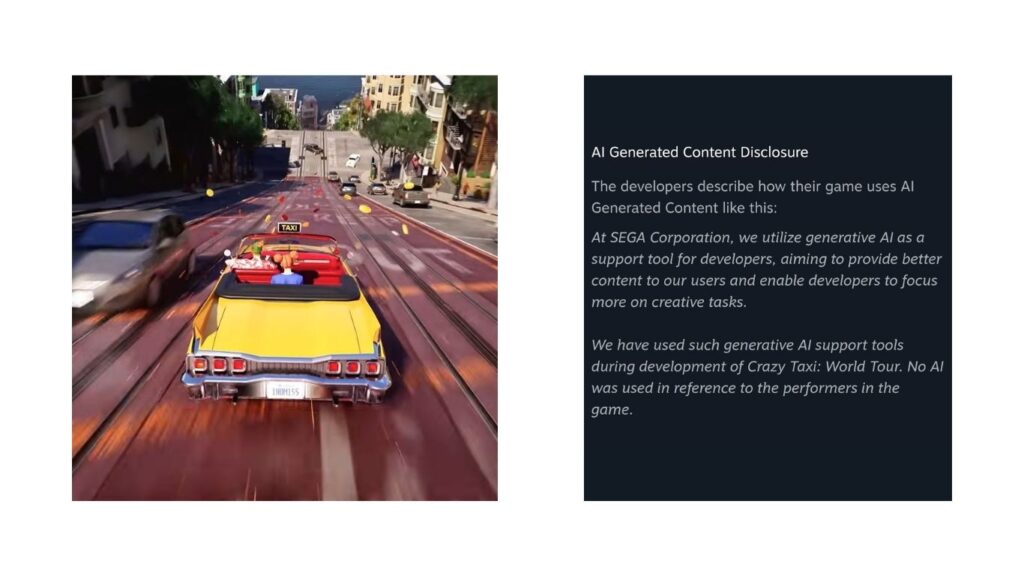
Within hours of the World Tour announcement, Sega confirmed that generative AI was used during development, specifically to create background assets. Predictably, some fans were outraged. Some dismissed the concern entirely. Neither reaction is particularly useful.
Here is where I actually stand: AI as a tool in game development is not automatically a bad thing. Game studios spend enormous amounts of time and money building environments, textures, and background details that most players will never consciously notice. If an AI tool helped Sega fill out the streets of a Tokyo or Paris level faster than a human artist painting every shop sign individually, I do not think that is a moral catastrophe.
But the word “acceptable” comes with a condition: transparency.
Sega’s statement was vague. They said generative AI was used as a “support tool” and that everything was subject to human review. That is a start, but it is not enough. How much of the game’s visual world was AI-generated? Were the human artists who would have done that work still employed and working on other parts of the game, or were they replaced? What exactly does “human review” look like in practice? Is it a thorough creative process or a quick sign-off?
These are not paranoid questions. They are reasonable ones, and the gaming community deserves clear answers. The reason people get nervous when studios announce AI involvement is not because every fan is a technophobe. It is because the history of large studios using efficiency tools has sometimes meant fewer jobs for the artists, writers, and developers who give games their texture and soul.
Think about what makes a great game world feel alive. It is the small detail that somebody decided to put there. The worn poster on a wall. The specific way a street corner looks at night. Those choices come from human imagination and human experience. If AI is generating those details en masse without meaningful creative direction, something real gets lost even if it is hard to point to exactly what.
Sega needs to be more forthcoming about how AI was used and what guardrails were in place. Not because generative AI is inherently wrong, but because trust between developers and their communities is hard to build and easy to break. The announcement already has people asking questions. Getting ahead of those questions with honest, specific answers would do a lot more for the game’s reception than leaving fans to speculate.
The soundtrack and why it matters more than you think
One detail in the World Tour reveal that I think deserves more attention than it got: the soundtrack situation.
The original Crazy Taxi without its music is a fundamentally different and lesser game. This is not an exaggeration. When the PS3 and Xbox 360 ports of the original game lost their music licenses in 2010, replacing The Offspring and Bad Religion with generic tracks, the games became almost unrecognisable in terms of feel. The music was not background noise in Crazy Taxi. It was the engine. It set the pace, the attitude, and the energy of every single ride.
Kenji Kanno told press this week to “keep expectations high” for the artists Sega is working to bring on board, and the World Tour demo already featured The Offspring’s “All I Want.” That is a genuinely encouraging sign. Securing those licences is not cheap or easy. The fact that Sega has done it for even the demo suggests they are taking the soundtrack seriously.
If World Tour arrives with a full punk-rock and ska-punk soundtrack in the spirit of the original, it will already feel right before a single passenger is picked up. That is how important this part of the game is.
The bottom line
Crazy Taxi: World Tour is arriving in 2027, and I am genuinely looking forward to it in a way that I have not felt about a gaming announcement for a while. Not because the trailers showed us a perfect game, but because the soul of the original is clearly present. The yellow cab is back. Axel is back. The Offspring is back. And Kenji Kanno, the man who dreamed all of this up in the first place, is driving.
The balancing act between arcade simplicity and modern ambition is real, and Sega will need to get it right. The AI conversation is real too, and Sega needs to handle it with more honesty than they have shown so far.
But right now, in a gaming landscape full of live service games that demand your time and battle passes that demand your wallet, the idea of a game that just lets you drive fast, earn big, and feel completely free for a few hours? That is not just nostalgia talking.
That is exactly what gaming needs right now.