
How the future of AI agents is changing everything you know about work

We have all seen the headlines about how artificial intelligence is going to change the world. For the last couple of years, most of that talk has centered around chatbots like ChatGPT that can write poems or summarize long documents. While that was impressive, it was only the beginning. We are now moving into a much more exciting and slightly terrifying phase of technology. The future of AI agents is here, and it is about to turn our understanding of productivity upside down.
Unlike the tools we have used before, these agents do not just talk. They act. Imagine a world where you do not have to spend hours booking flights, managing your calendar, or organizing complex data spreadsheets. Instead, you give a single command to a digital assistant that understands your goals and executes the plan from start to finish. This is not science fiction anymore. It is the core of the next industrial revolution.
What exactly are these autonomous assistants?
To understand why the future of AI agents is such a massive deal, we need to define what they actually are. At its simplest level, an AI agent is a software program that can interact with its environment. It perceives what is happening, reasons through a problem using a large language model, and then takes action to achieve a specific goal.
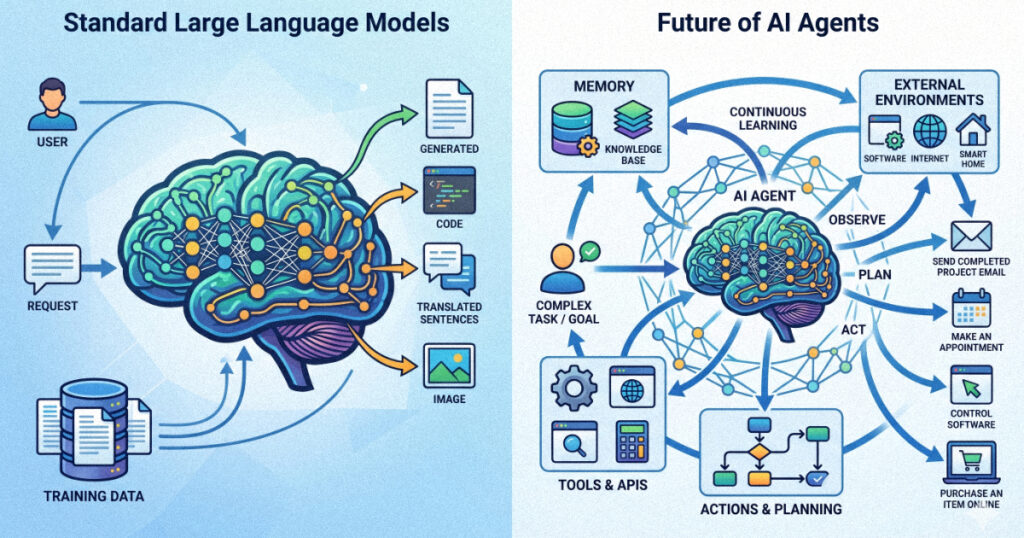
Think of a standard chatbot as a very smart librarian. You ask it a question, and it gives you information. An AI agent, on the other hand, is like a highly skilled executive assistant. If you tell a librarian you want to go to Hawaii, they might give you a book on travel. If you tell an AI agent you want to go to Hawaii, it will find the best flights, book the hotel, rent a car, and add the entire itinerary to your calendar without you lifting a finger.
This ability to take action is what separates “agentic” workflows from simple generative AI. These systems are designed to be autonomous. They do not need a human to hold their hand at every single step. They can break down a complex project into smaller tasks and complete them one by one.
Why the future of AI agents is different from basic chatbots
Many people confuse the current crop of AI tools with the autonomous agents of the future. The primary difference lies in the way they process information and interact with other software. Most current AI models are “reactive.” They wait for a prompt and then give a response.
The future of AI agents involves “proactive” behavior. These systems are equipped with what experts call a reasoning engine. This means they can look at a problem, realize they are missing a piece of information, and then go find that information on the internet or in a private database. They can use external tools, like a calculator or a coding environment, to make sure their work is accurate.
Because they can use tools and browse the web just like a human, their potential is nearly limitless. They are moving from being just a brain in a box to being a hand that can actually move things in the digital world. This shift is why so many tech giants are pouring billions of dollars into agentic research.
Transforming the workplace with agentic workflows
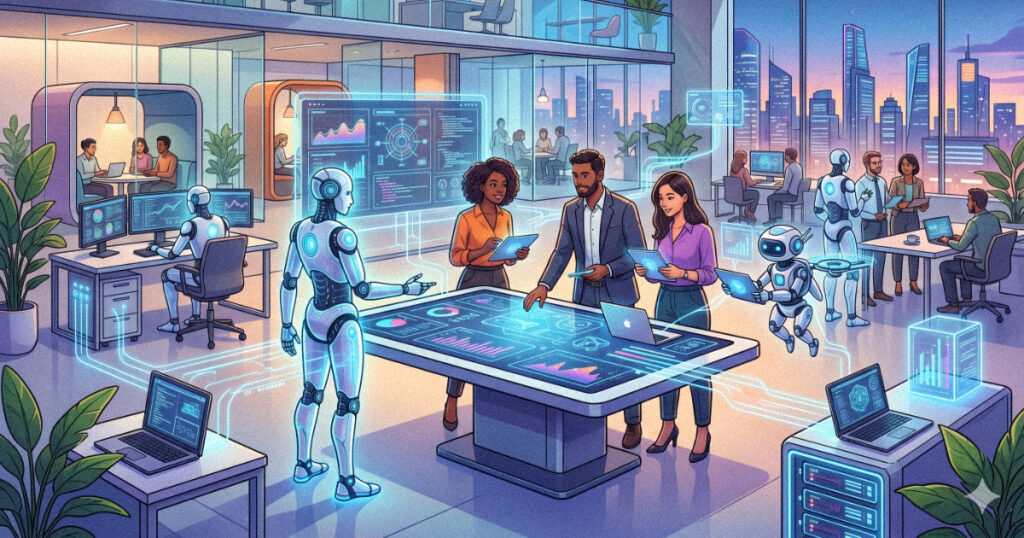
The impact on the professional world will be massive. In the near future, we will see the rise of multi-agent systems. This is where different AI agents, each specialized in a specific task, talk to each other to complete a large project.
For example, in a software company, you might have one agent that specializes in writing code, another that specializes in finding bugs, and a third that focuses on user experience. These agents will work together in a loop. The coder writes the script, the bug-finder tests it, and the UX agent ensures it looks good. This happens in seconds rather than days.
The future of AI agents also means that the barrier to entry for starting a business will drop significantly. A single entrepreneur could essentially lead a team of fifty “digital employees” that handle everything from customer support to marketing and accounting. This level of efficiency will allow humans to focus on the creative and strategic parts of work while the agents handle the repetitive and data-heavy tasks.
The industries that will see the biggest changes
While every sector will feel the impact, some industries are perfectly suited for the future of AI agents. Healthcare is a prime candidate. Agents can monitor patient data in real time, cross-reference it with the latest medical research, and alert doctors the moment a potential issue arises. They can even handle the complex administrative work of insurance claims.
In the world of finance, AI agents are already being used to detect fraud and manage portfolios. But the future will take this further. Agents will be able to navigate complex global regulations to ensure that every transaction is compliant, saving banks millions in legal fees.
Customer service is perhaps the most obvious area for a total overhaul. We are moving past the days of frustrating automated phone menus. Future agents will have a full memory of your history with a company. They will speak to you in a natural, empathetic way and solve your problem immediately by accessing the necessary back-end systems.
Addressing the challenges and ethics of autonomy
Obviously, with great power comes great responsibility. The future of AI agents brings up some serious questions about safety and ethics. If an agent is allowed to make purchases or change code on its own, what happens if it makes a mistake? Who is responsible when an autonomous system fails?
There is also the concern of “hallucinations” where an AI might confidently do the wrong thing. Developers are working hard to create guardrails and “human-in-the-loop” systems. This ensures that while the agent does the heavy lifting, a human still has the final say on the most important decisions.
Privacy is another major hurdle. For an AI agent to be truly useful, it needs access to your data. It needs to know your schedule, your preferences, and your goals. Ensuring that this data is stored securely and not used for malicious purposes will be the defining challenge of the next decade.
How to prepare for an agentic world
The shift toward autonomous systems is happening faster than most people realize. To stay relevant, professionals and businesses need to start thinking about how they can integrate these tools today. This does not mean you need to be a computer scientist. It means you need to get good at “agent orchestration.”
Learning how to direct these agents and manage their output will be one of the most valuable skills in the job market. We are moving from a world where we “do” the work to a world where we “review” and “direct” the work.
The future of AI agents is not about replacing humans. It is about supercharging human potential. By offloading the boring, repetitive, and complex technical tasks to autonomous assistants, we free ourselves up to be more human. We can spend more time on strategy, connection, and big-picture thinking.
In conclusion
We are standing at the edge of a massive shift in how technology serves humanity. The journey from simple search engines to conversational chatbots was a big leap, but the transition to autonomous agents will be even bigger. The future of AI agents promises a world where our digital tools finally understand what we want and have the power to make it happen.
As these systems become more integrated into our daily lives, the line between software and assistant will disappear. We will no longer “use” a computer. We will collaborate with a digital partner. The possibilities are endless, and the revolution has only just begun. It is time to embrace the agentic future and see just how far it can take us.