
Why the speed of darkness is officially faster than light

Why the speed of darkness is officially faster than light
For over a century, the scientific world has lived by a single, unbreakable rule: nothing travels faster than the speed of light. Albert Einstein built his theory of relativity on this foundation, claiming that the vacuum speed of $300,000$ kilometers per second is the ultimate limit of the universe. However, a stunning new experiment from the Technion-Israel Institute of Technology has turned this logic on its head. Researchers have successfully measured the speed of darkness, and it turns out that shadows and dark points are actually capable of outrunning light itself.
This discovery is not just a theoretical fluke. It is a direct observation of how the universe behaves when we look at the gaps between light waves. While we usually think of darkness as a passive absence of light, this study reveals that dark points, also known as optical phase singularities, have their own dynamic properties. By tracking these points with ultra-high precision, the team led by Professor Ido Kaminer has confirmed that the speed of darkness can reach superluminal velocities, effectively “breaking” the speed limit that has governed our understanding of physics for decades.
Understanding the revolutionary speed of darkness discovery
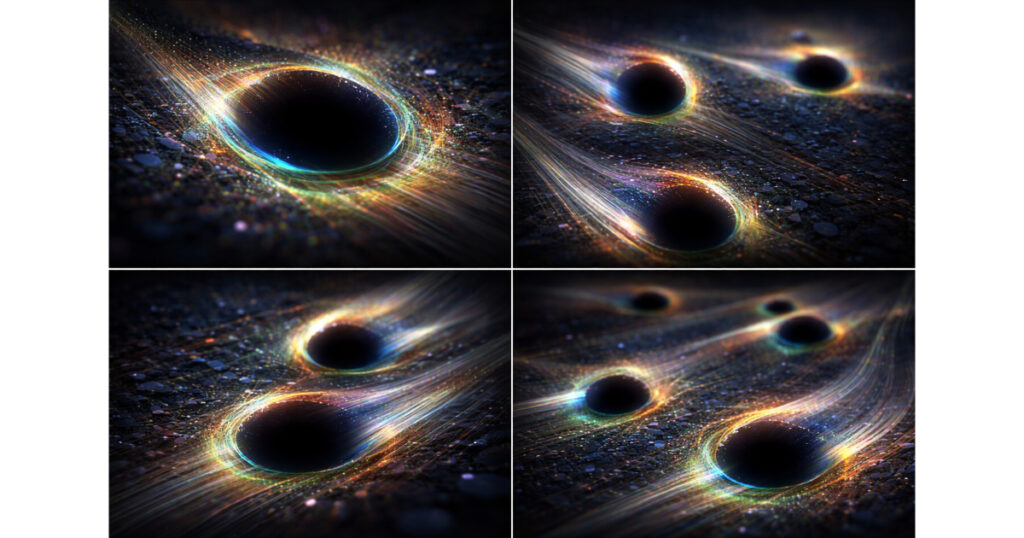
The concept that the speed of darkness could be faster than light sounds like something out of a science fiction novel, but it is grounded in the geometry of waves. To understand this, scientists looked at what they call “optical vortices.” These are essentially whirlpools or holes within a light wave where the intensity drops to zero. Imagine a river flowing at a steady pace. If you stir that water, you create a vortex. That vortex can move across the river faster than the water molecules themselves are flowing.
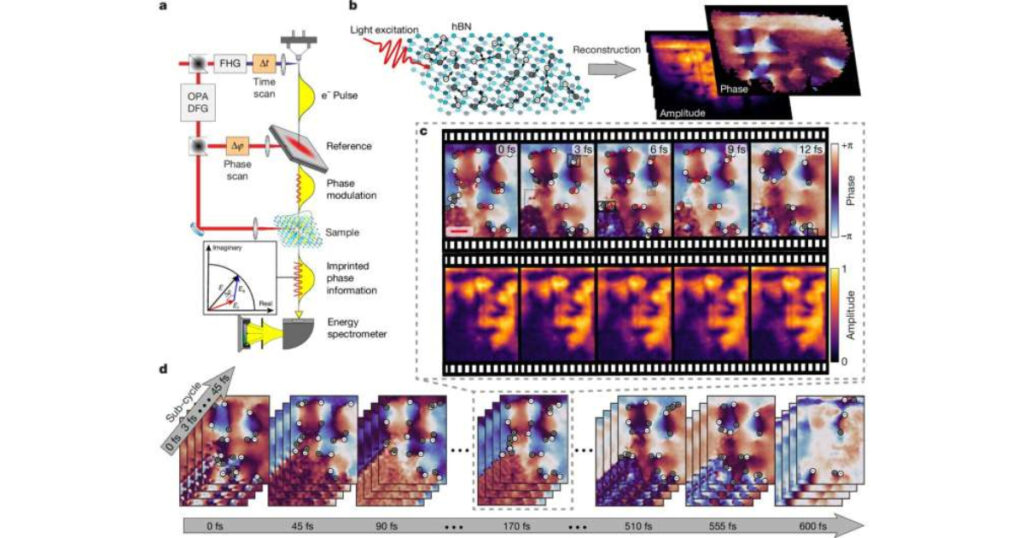
The researchers at Technion used a similar logic to measure the speed of darkness. They worked with a specialized material called hexagonal boron nitride, which allowed them to slow down light waves by turning them into “light-sound” hybrids known as polaritons. Once the light was slowed, they could observe the dark points within the waves with incredible detail. What they found was shocking. About $29$ percent of these dark singularities were moving at speeds exceeding the vacuum speed of light. On average, the speed of darkness in their experiment was measured at approximately $1.04$ times the speed of light.
How the speed of darkness defies classical physics
Most people assume that darkness is just “nothing.” If you turn off a flashlight, the darkness appears instantly. However, in the world of quantum optics, darkness is much more complex. It is a structured part of the electromagnetic field. The speed of darkness is governed by the evolving geometry of the wave rather than the physical movement of particles. This is why it can move so fast. Because a dark point is not a physical object with mass, it is not weighed down by the energy requirements that prevent matter from reaching the speed of light.
When two of these dark points, or singularities, approach each other, they begin to accelerate. The math behind this predicts that right before they collide and annihilate, their velocity becomes “unbounded.” This means that the speed of darkness can, in theory, reach any speed, no matter how high. The Technion team was the first to actually catch this in the act. They used an ultrafast transmission electron microscope to take snapshots every few femtoseconds. A femtosecond is one-quadrillionth of a second. This allowed them to see the dark points jumping across space in ways that light simply cannot.
The technical reality of measuring the speed of darkness
Capturing something that moves faster than light requires technology that operates at the very edge of human capability. The researchers had to build a specialized microscopy setup that combined a laser system with an electron microscope. This gave them a spatial resolution of $20$ nanometers. To put that in perspective, a human hair is about $80,000$ nanometers wide. By looking at things on this nanoscale, the team was able to map the exact trajectory of these dark holes as they hurtled through the material.
The material used, hexagonal boron nitride, was chosen because it creates a “slow-motion” environment for light. This made the superluminal behavior of the dark points stand out much more clearly. If they had conducted the experiment in a vacuum, only a tiny fraction of the points would have appeared to break the speed limit. But because of the unique properties of this material, the speed of darkness became a dominant feature of the experiment. It showed that nature has hidden processes that move at incredible speeds, and we are only now developing the tools to see them.
Why the speed of darkness does not break Einsteins rules
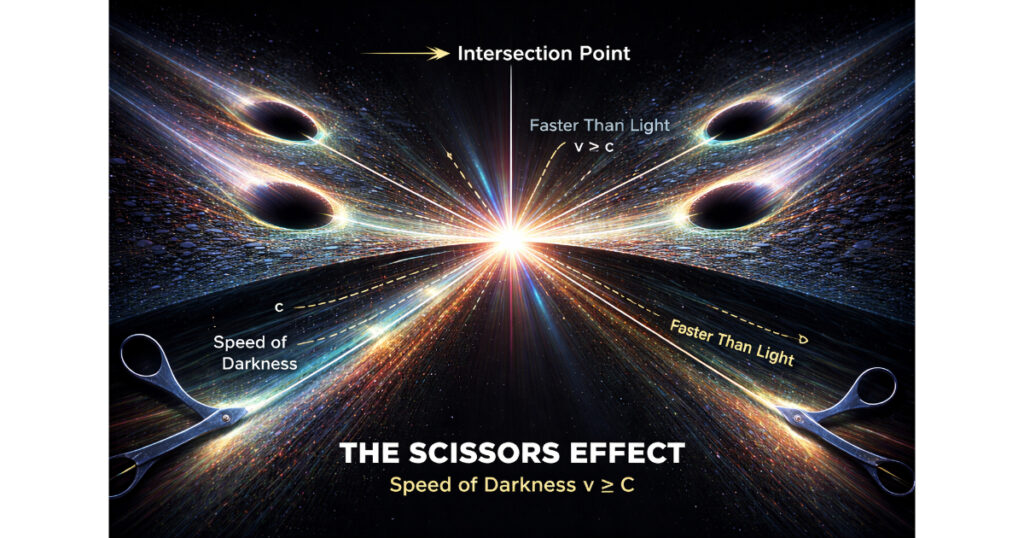
You might be wondering how this discovery fits with Einstein’s theory of relativity. If nothing can go faster than light, why is the speed of darkness allowed to break the rule? The answer lies in what is actually moving. Einstein’s law specifically applies to matter, energy, and information. You cannot send a text message or a physical rocket faster than light. However, a dark point is an “absence.” It carries no mass and no information.
Think of it like a shadow cast on the moon. If you wave your hand in front of a powerful laser pointed at the moon, your shadow could sweep across the lunar surface at speeds much higher than the speed of light. But you haven’t actually moved anything from Earth to the moon at that speed. The shadow is just a geometric consequence. The speed of darkness works the same way. It is a change in the pattern of the wave, not a physical object traveling through space. This allows it to move as fast as the math permits without violating the fundamental laws that keep our universe from falling apart.
Practical implications of the speed of darkness study
While the study is a triumph for pure physics, it also has practical potential for future technology. By understanding how these dark singularities move, scientists can create better ways to map the inside of materials. The speed of darkness can be used as a probe to see delicate processes in biology and chemistry that happen too fast for conventional light to capture. It provides a new “clock” for the fastest moments in nature.
The researchers believe this is just the beginning. Now that they have proven they can track these superluminal points in two dimensions, they plan to move to three-dimensional systems. This will reveal even more complex behaviors of waves and could lead to breakthroughs in quantum computing and high-speed imaging. The study of the speed of darkness is essentially opening a new window into a world that was previously invisible to us.
Tangible updates on research and findings
For those interested in the specifics of this scientific breakthrough, here are the tangible facts regarding the research:
- Lead Institution: Technion-Israel Institute of Technology.
- Publication Date: March 2026.
- Journal: Nature.
- Measured Velocity: Approximately $3.12 \times 10^8$ meters per second (approx $1.04c$).
- Resolution Specs: $20$ nanometers (spatial) and $3$ femtoseconds (temporal).
- Material Platform: Hexagonal boron nitride (hBN).
- Key Scientists: Professor Ido Kaminer and Professor Hanan Herzig Sheinfux.