Seagate HAMR SMR drives get Broadcom HBA support: what it means for data storage

Seagate HAMR SMR drives get Broadcom HBA support
Quick answer: Seagate HAMR SMR drives have been added to Broadcom’s approved vendor list for its Broadcom HBA, the card that connects servers to hard drives. Microsoft Azure Storage has also qualified the setup. In plain words, big data centers can now add more storage per drive with fewer compatibility worries.
If you have ever run out of space on your phone, you already understand the problem that giant data centers face every day. The difference is scale. AI tools, streaming apps and cloud services create so much data that companies need to add storage all the time. A recent announcement from Seagate is aimed at exactly that problem.
Seagate HAMR SMR drives are now officially supported on a widely used Broadcom connection card, and Microsoft Azure has tested the setup too.
That sounds technical, so let us break it down in simple words, step by step.

What Seagate announced
Seagate says its Mozaic drives, which use a technology called HAMR and are set up with a method called SMR, are the first and only SMR drives on Broadcom’s approved vendor list for its host bus adapter. A host bus adapter, or HBA, is a card that lets a server talk to many hard drives at once.
Microsoft Azure Storage has also finished its own qualification of the Broadcom HBA together with Seagate’s HAMR and SMR technology. This matters because Azure runs storage at a huge scale, so passing its checks is a real-world proof point, not just a lab claim.
Three names appear in this story, and each has a simple job:
- Seagate makes the hard drives.
- Broadcom makes the HBA, the connector card between the server and the drives.
- Microsoft Azure is a big cloud user that tested whether the two work well together.
Why data keeps growing so fast
Every photo you upload, every video you stream and every question you ask an AI chatbot leaves data behind somewhere. AI models also need huge piles of data to learn from. Seagate describes AI and cloud growth as the reason companies need storage that can scale in an efficient way.
There is a second problem that people often miss. It is not enough to buy bigger drives. A company must also connect them, address them and manage thousands of them without chaos. That is where hyperscale data storage gets difficult, and why this announcement is about connection and management, not only capacity.
What HAMR means, with a simple picture
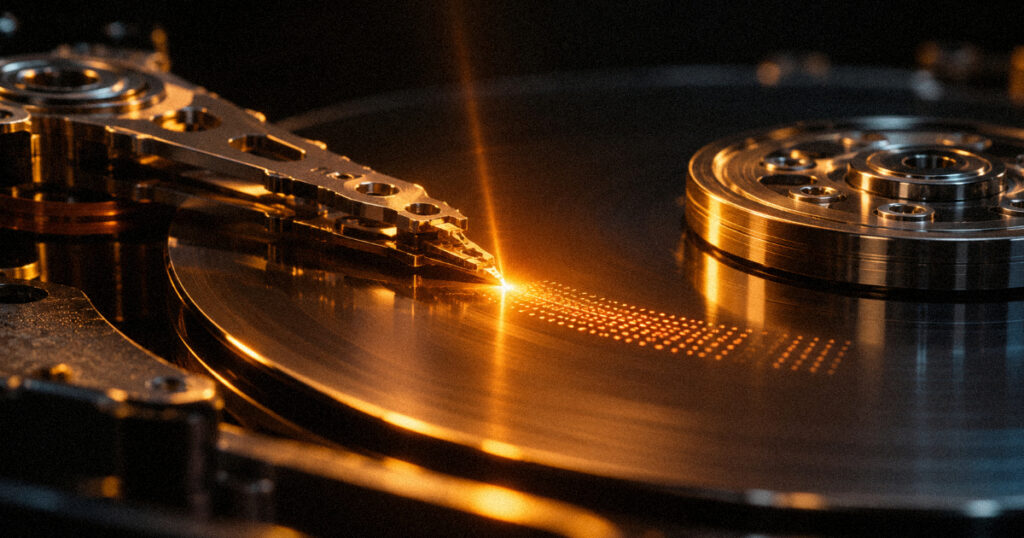
HAMR stands for heat-assisted magnetic recording. A hard drive stores information by changing tiny magnetic spots on a spinning disk. To store more data, those spots must become smaller. But very small spots are hard to change, because they resist being written.
HAMR solves this by using a tiny burst of heat from a laser. The heat makes the spot easier to write, then it cools quickly and holds the data firmly. Think of writing on soft, warm wax compared with cold, hard wax. Warm wax lets you write finer details.
This is the base of Seagate Mozaic, the company’s platform for raising storage density and drive capacity over time.
What SMR means and why it adds space
SMR stands for shingled magnetic recording. Picture the roof of a house. Roof tiles overlap each other like fish scales, so you can fit more tiles in the same area. SMR does the same thing with data tracks on a disk. The tracks partly overlap, which lets the drive hold more data on the same surface.
There is a catch. If you want to change data in the middle of an overlapped area, the drive may need to rewrite the neighbouring tracks as well, just as fixing one roof tile may mean lifting the ones next to it. So SMR works best when data is written in order and not changed often.
The press release says it plainly: SMR increases usable capacity for appropriate workloads. The words “appropriate workloads” are important, and we will come back to them below.
What the Broadcom HBA does and why approval matters
The Broadcom HBA acts like a traffic controller in a busy railway station. Many trains (drives) need to be connected, tracked and sent to the right platform, and the controller makes sure the server knows which is which.
Being on Broadcom’s approved vendor list means the HBA maker has confirmed that these drives are supported. For a company buying thousands of drives, that is a big comfort. It lowers the risk of strange bugs, lost time and expensive surprises when the hardware is switched on.
Broadcom’s Jas Tremblay said the expanded support gives more customers a simple path to bring in and manage high-capacity drive fleets. Seagate’s Jason Feist said the aim is to make high-capacity SMR storage easier to deploy.
A real-world style example: a video AI startup
Here is a made-up but realistic example to show how this works in practice. The company and its numbers are only for illustration.
Meera is an infrastructure lead at ClearFrame, a startup that trains AI models to spot problems in factory camera footage. Every day the cameras produce hours of video. The team saves it all, because old footage is useful for training new models later. Once a clip is saved, it is almost never edited. It is written once and read many times.
ClearFrame’s storage bill grows every month. Meera has three choices: buy many more drives, rent more cloud space, or use denser drives. Denser drives look attractive, but she worries about one thing. Will they work smoothly with the server cards her team already uses?
This is where the news helps. If her servers use a Broadcom HBA, the Seagate drives she is considering are now on the approved list, and a large operator like Azure has tested the setup. She still runs her own tests, but the risk feels much smaller. And because her data is written once and read often, SMR suits it well. She can store more footage per drive without redesigning her whole system.
Now imagine ClearFrame also runs a customer database that is updated every second. Meera would not put that on SMR drives. It needs constant rewriting, which is the weak spot of overlapping tracks. She would keep that on a different type of storage. Picking the right drive for the right job is the whole idea.

What the Azure qualification tells us
Microsoft’s Pablo Ziperovich said that large data centers need storage that meets strict needs for interoperability, manageability and efficiency. He added that the joint validation shows the technologies can work together across large deployments, giving more storage density at a similar cost and power envelope.
In simple terms, “interoperability” means different products work well together, even when different companies made them. At hyperscale, small mismatches become big problems, so a successful qualification is a strong sign of maturity. It is still the view of the companies involved, so treat the efficiency claims as their statement until more independent data appears.
Who benefits and who should wait
Who is likely to benefit:
- Cloud providers and large data centers that store huge amounts of data that rarely changes, such as backups, archives, logs, video and AI training data.
- Teams that already use Broadcom HBAs and want a clear, supported path to denser drives.
- Companies that care about packing more storage into the same space and power budget.
Who should be careful:
- Anyone whose data changes all the time, such as busy databases.
- Teams that have not checked whether their software handles SMR drives well.
- Small businesses that only need a few drives, since the biggest gains show up at scale.
Also note what the announcement does not say. The release does not share drive sizes, prices or speed numbers, so you cannot judge cost savings from it alone. Always test with your own workload before you commit.







[…] is a data center? In simple words, a data center is a building, or a part of a building, that is filled with […]